


Cleanroom factory automation & GMP integration for Life Sciences and Pharmaceuticals
Build cleanroom environments that protect product integrity and ensure audit readiness.
Overview
Re-thinking cleanroom factory automation
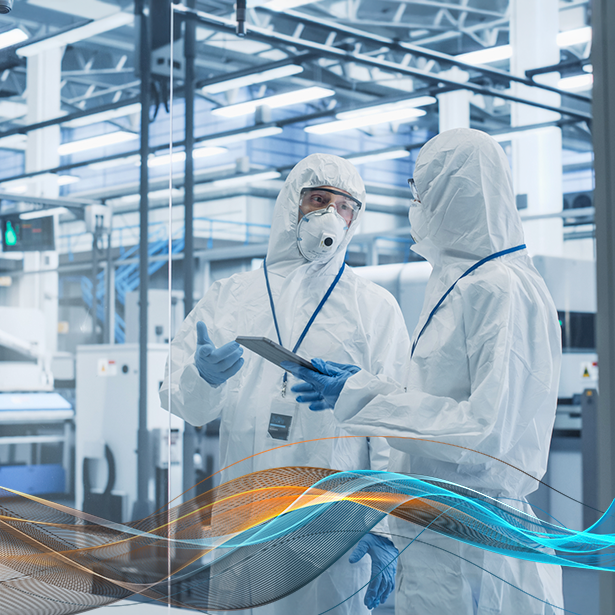
A cleanroom is a controlled environment designed to minimize contamination, including particles, microbes, and chemical vapors, by using engineered airflow, filtration, pressure differentials, temperature, humidity control, and disciplined operating procedures.
- Patient safety: contamination can compromise efficacy and safety.
- Regulatory compliance: clean room performance is central to GMP expectations and inspection outcomes.
- Product quality and yield: stable environmental control reduces defects, scrap, and rework.
- Operational resilience: predictable environmental performance supports repeatable, scalable manufacturing.
We solve
Industry challenges
- Higher contamination risk (particles, bioburden, cross-contamination)
- Regulatory exposure (observations, CAPAs, delayed release)
- Inconsistent process outcomes from humidity/temperature swings
- Unplanned downtime due to reactive cleaning and investigations
- Scale-up friction when pilot success doesn’t translate to production
- Higher total cost from scrap, rework, and extended cycle time
These risks are often amplified when automation is introduced without considering airflow behavior, material flow, and cleanroom operating discipline.
Capabilities
What we build
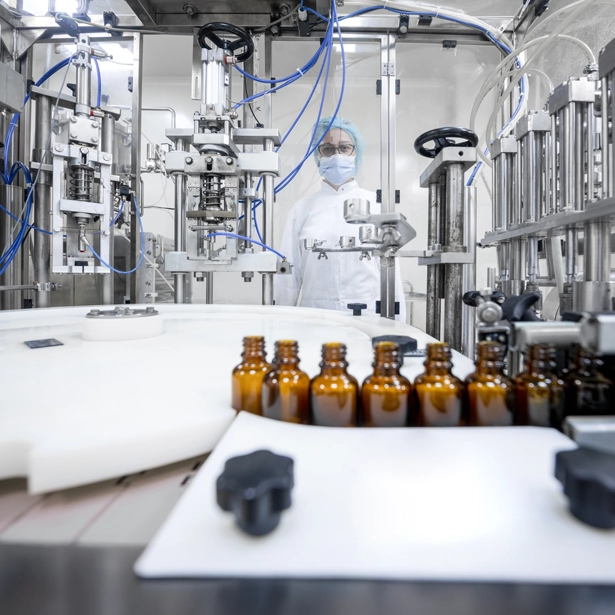
Cleanroom-compatible automation is not standard automation placed into a clean space; it requires deliberate choices in materials, motion, airflow interaction, and maintenance strategy. A systems approach: clean room aware design + automation engineering + disciplined execution. We integrate cleanroom compatible equipment and automation, ensuring your process, environment, and documentation work together to support production performance and defensibility in audits. We support clean room success across the full lifecycle:
As cleanroom automation continues to evolve, greater use of AI and machine learning is enabling smarter decision-making, adaptive behavior, and fewer contamination-prone touchpoints. A clean room-ready manufacturing solution that protects quality, accelerates time-to-production, and holds up under inspection.
Cleanroom-aligned equipment and automation design
Designing stations, cells, and lines that minimize particle generation, simplify cleaning, and support gowning workflows.
Material + personnel flow strategy
Layout and handling concepts that reduce cross-contamination risk and human error.
Contamination – aware automation
Robotics and conveyance are engineered to reduce contact points, turbulence, and particulate generation. This can include the use of autonomous mobile robots (AMRs) for material movement, collaborative robots for controlled operator-assist tasks, and advanced vision systems to reduce manual interaction.
Validation and document support
Documentation packages and execution discipline that help teams move efficiently through qualification and change control.
Integration for monitoring and control
Aligning equipment behavior with environmental requirements supporting alarms, interlocks, traceability and automated monitoring where required..
Scalable, repeatable build standards
Standardizing the right elements so you can replicate performance across programs and sites.
Benefits
Why Life Sciences and Pharmaceuticals companies choose Eclipse for cleanroom factory automation
We partner with life sciences and pharmaceutical manufacturers to design, engineer, and integrate cleanroom-compatible automation systems that reduce contamination risk, improve yield, and accelerate time-to-production. Our experience spans common ISO Class 7 and 8 manufacturing environments, with selective support for ISO Class 5 and 6 applications where product sensitivity and process risk demand tighter control.
Improved product quality
Through tighter contamination control.
Higher yield
With stable environmental performance.
Audit readiness
With documented controls and traceable procedures.
Faster scale-up
By standardizing critical environmental procedures and parameters.
Reduced operational risk
Through engineered segregation and controlled workflows
Reduced human intervention
Through automation designed specifically for cleanroom operation.
The future of cleanroom looks toward greater integration of AI robotics, vision, AMRs, cobots, vision systems and machine learning, enhancing the ability of robots to make decisions and perform complex tasks autonomously. Advances in materials science are also expected to produce new types of robots that shed even fewer particles, thus further reducing contamination risks.
The Automation Lifecycle
Explore the Eclipse factory automation lifecycle
One partner. One process.
We bring your automation project to life—from strategy to launch and beyond. It all starts with smart planning: mapping your processes, validating ideas, and identifying the right solution.
This foundation fuels a proven end-to-end lifecycle that spans advanced engineer services (AES), pre-automation system development, vertical integration, and post-launch optimization. By aligning goals early and managing everything under one roof, you gain a faster, more confident path forward with reduced risk.
FAQ
Frequently asked questions
Do I need a cleanroom for my product or process?
If contamination can impact safety, efficacy, sterility, stability, or regulatory compliance, a cleanroom or cleanroom-grade controls around critical steps may be required. Many teams adopt a risk-based approach to determine where classification and controls are necessary.
What’s the difference between a cleanroom and a controlled environment?
A cleanroom meets defined contamination limits (typically tied to ISO classification and validated performance). A controlled environment may manage temperature/humidity, but doesn’t necessarily control particles/microbes to cleanroom standards.
How do cleanrooms impact manufacturing cost and throughput?
Cleanrooms add upfront and operating costs, but they often reduce total cost by preventing batch failures, deviations, and rework. The best designs balance compliance, uptime, and maintainability to protect throughput.
How does automation affect cleanroom performance?
Well-designed automation can reduce human contact and variability, improving consistency. Poorly designed automation can generate particles, complicate cleaning, or disrupt airflow.
What are the most common causes of cleanroom contamination?
People (gowning and behavior), material transfer, poor airflow/pressure control, inadequate cleaning, high-particle equipment, and uncontrolled maintenance activities are frequent sources.
How can Eclipse Automation support a cleanroom build or upgrade?
We help design and integrate cleanroom-ready automation and manufacturing systems aligned to contamination control, documentation discipline, and scalable production needs so your process, equipment, and environment work together.
Featured articles and insights
-
Life sciences manufacturing: Smarter, flexible automation for modern facilities
Life sciences automation enables flexible, compliant manufacturing for rapidly evolving medical technologies.
-
Industry segment: Medical device manufacturing
Watch the video: See how automation enables compliant medical manufacturing.
-
Contract manufacturing is growing at 9+%—how it can work for your next high-stakes project
Contract manufacturing provides scalable production and specialized expertise.
