


Hydrogen cell factory automation
Power the future with automated hydrogen cell assembly, streamlining production while enhancing efficiency and safety
Overview
Re-thinking hydrogen cell factory automation
Hydrogen cell factory automation requires precise, efficient, and safe production processes. Factories face challenges in automating complex assembly, ensuring consistent quality, minimizing downtime, and scaling operations to meet growing clean energy demand. Advanced factory automation solutions streamline workflows, optimize performance, and enable manufacturers to produce smarter, faster, and more reliably.
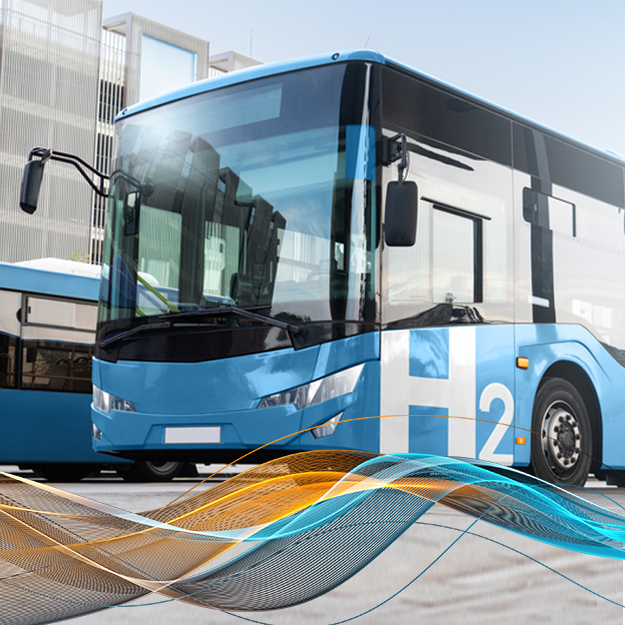
Watch the video
Discover how Eclipse can transform your hydrogen cell assembly.
We solve
Industry challenges
- Complex and labor-intensive assembly
Hydrogen cells require precise assembly of sensitive components. Manual processes can slow production, introduce errors, and limit scalability. - Quality control and consistency
Maintaining tight tolerances and defect-free products is critical for safety and performance. - Safety and regulatory compliance
Handling flammable materials and high-pressure systems presents significant risks. - Scaling production to meet demand
Rapidly growing clean energy markets require flexible, scalable manufacturing solutions. - Data digitization, AI & generative AI integration
Legacy systems and fragmented data hinder predictive maintenance, operational insights, and process optimization. - Energy and resource optimization
Hydrogen cell production can be resource intensive.
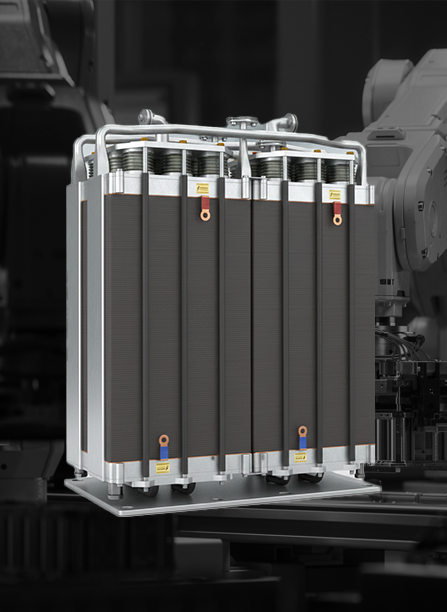
Our expertise
Our solutions in hydrogen technology automation
Hydrogen technology automation is a critical component in the global clean energy transition, and its production requires tightly controlled, scalable processes. Our transportation automation expertise helps manufacturers reduce risk, increase throughput, and maintain the consistency needed for commercial fuel cell performance. As a trusted partner in advanced transportation automation, we enable our clients to lead in zero-emission mobility.
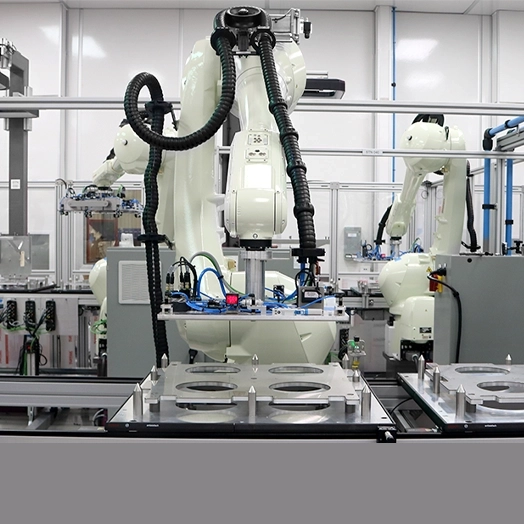
Hydrogen fuel cell stacking:
Automating the precise stacking of hydrogen fuel cell layers.
Electrolyzer assembly:
Building complete electrolyzer units to support scalable hydrogen production.
Proton Exchange Membrane (PEM) assembly:
Assembling PEMs to maximize conductivity and fuel cell efficiency.
Membrane Electrode Assembly (MEA):
Integrating MEAs using controlled processes.
Web-handling systems:
Managing delicate roll-to-roll materials with advanced web-handling systems.
Surface treatment technologies:
Preparing material surfaces using specialized treatments to enhance bonding, conductivity, or functionality.
Adhesive dispensing and curing:
Applying and curing adhesives for reliable structural and functional bonds.
Separator sheet handling:
Handling separator sheets, maintaining integrity and positioning in automated processes.
Precision stacking:
Stacking thin components to meet demanding performance and quality standards.
Vision guided motion/alignment:
Using real-time machine vision for dynamic, high-speed assembly.
Integrating data systems:
Connecting automation systems to enterprise data platforms for real-time monitoring, traceability, and optimization.
FAQs
Frequently asked questions
Why is automation important for hydrogen fuel cell production?
Hydrogen fuel cell production requires extremely precise assembly of delicate components like PEMs and MEAs. Automation reduces human error, maintains tight tolerances, increases throughput, and ensures consistency across production. It is essential for scaling clean energy technologies while meeting performance and safety standards.
How does Eclipse Automation automate hydrogen fuel cell manufacturing?
Eclipse designs precision automation systems for hydrogen fuel cell production, including fuel cell stacking, PEM and MEA assembly, and web-handling processes. Our solutions ensure consistent layer alignment, accurate material handling, and high throughput, helping manufacturers scale production while maintaining performance, reliability, and quality standards.
How does Eclipse Automation ensure quality and traceability in hydrogen automation?
Eclipse integrates machine vision and real-time data monitoring into hydrogen automation systems to ensure precise alignment, defect detection, and process optimization. By connecting automation to enterprise data platforms, manufacturers gain full traceability, improve yield, and maintain strict quality control for commercial-scale fuel cell production.
What are the main challenges in hydrogen cell factory automation?
Key challenges include handling delicate materials without damage, maintaining precision during stacking and assembly, ensuring repeatable quality at scale, integrating specialized components into efficient lines, and connecting systems to data platforms for monitoring and optimization. Automation systems are critical to overcoming these challenges efficiently.
What specialized hydrogen manufacturing processes does Eclipse Automation support?
Eclipse supports a wide range of hydrogen production processes, including electrolyzer assembly, separator sheet handling, precision stacking, surface treatment, and adhesive dispensing/curing. Each system is designed for high accuracy and repeatability, reducing manual intervention and minimizing risk to delicate materials critical for fuel cell efficiency.
Featured articles and insights
-

Eclipse Automation Marks 25 Years with Strategic Expansion, New Partnerships, and Bold Vision for the Future of Factory Automation
Cambridge, Ontario — March 12, 2026, Eclipse Automation, a global leader in factory automation, today announced…
-
Another year of building what’s next: A look back at 2025 at Eclipse Automation
2025 highlighted Eclipse Automation’s customer success, industry leadership, and global growth.
-

The Predictability Playbook: How automation strengthens consumer supply chains
Predictability is emerging as a core benefit of manufacturing automation.
