




The USA is entering a new era of industrial resurgence. For decades, manufacturers offshored operations in pursuit of low-cost labor and global supply chain efficiencies. Today, those assumptions are being rewritten.
Rising geopolitical tensions, transportation volatility, supply shortages, and quality risks have all converged to push companies to reevaluate where they build and how they operate. The result is a powerful reshoring movement across the United States, redefining the future of advanced manufacturing.
At the center of this transformation is factory automation. Automated production systems have become the strategic backbone enabling manufacturers to bring operations closer to home, improve cost structures, and scale with confidence. As a leader in turnkey automated solutions, Eclipse Automation has a unique perspective on how technology, labor evolution, factory digitization and innovation are fueling the return of high-value manufacturing across the continent.
Key Takeaways
- Factory automation is driving the US reshoring wave, making domestic manufacturing cost-competitive by offsetting labor costs, shortening supply chains, and enabling flexible, modular production.
- Automation strengthens resilience and quality, allowing local factories to rapidly adapt to demand shifts, ensure traceability, and meet stringent standards in sectors like EV batteries, semiconductors, medical devices, and nuclear energy.
- Digitalization multiplies automation’s impact, with IIoT, digital twins, and data analytics turning factories into smart, connected ecosystems that boost uptime, sustainability, and responsiveness.
- Reshoring success requires holistic planning, combining automation investment with workforce upskilling, flexible design, digital infrastructure, and smart use of federal incentives to build a sustainable, competitive US manufacturing base.
Factory automation: The catalyst for the reshoring
Reshoring isn’t simply about relocating a factory. It’s about rethinking the entire production model. Companies returning to the United States often face higher labor costs, stricter regulations, and a need for rapid time-to-market.
1. Factory automation narrows the labor-cost differential—sustainably
One of the strongest economic arguments for offshore production has historically been lower labor costs. Advances in factory automation and modern machine design materially reduce the labor intensity of many manufacturing processes, making local production increasingly cost-competitive. Intelligent automation—a blend of robotics, flexible conveyors, machine vision, and digital controls—reduces direct labor per unit while improving throughput and quality.
As Deloitte and other consultancies note, advances in machinery and automation are actively eroding the labor-cost advantage that once favoured overseas manufacturing. What this means practically: A U.S. plant equipped with modular factory automation can match or beat the landed cost of offshore production once you account for freight, tariffs, inventory risk, and the costs of extended lead times. For manufacturers considering reshoring, the calculus is no longer “labor only” — it’s total delivered cost, modularity and business continuity.
2. Factory automation creates resilient supply chains (and shorter, more responsive ones)
Reshoring is fundamentally a risk-management play: Closer supply chains shorten lead times and make companies far more responsive to demand swings, recalls, and regulatory change. But onshoring without factory automation can shift the fragility back home. The solution is to combine local capacity with automated flexibility — factories that can quickly retool for different SKUs, ramp volumes up or down, and run lean inventories.
Government programs such as the CHIPS Act and the Inflation Reduction Act (IRA) have catalyzed domestic investment — particularly in semiconductors, batteries, and clean energy manufacturing — making reshoring projects financially viable at scale. These public incentives are unlocking capital and generating a wave of announcements for new facilities across North America. The data shows the role of federal policy in making reshoring projects investable.
For example, automated lines equipped with quick-change tooling and digital twins permit manufacturers to respond to product changes or supply disruptions without lengthy, expensive downtime — a decisive advantage for nearshoring strategies.
3. Factory automation addresses the talent challenge — By augmenting, not replacing, people
A common concern about reshoring is the availability of the workforce. Modern factories succeed not by replacing workers with robots, but by elevating work: Factory automation removes repetitive, ergonomically risky tasks and creates higher-skilled operator, maintenance, and process roles. Better employee experience.
McKinsey’s research shows that a more innovative, more holistic approach to automation can mitigate talent shortages and recalibrate labour mixes toward higher-value activities. That shift matters for communities and for companies. When factory automation is paired with training programs and reasonable upskilling pathways, reshored plants become sources of durable, well-paid jobs.
Eclipse Automation encourages clients to pair factory automation deployments with workforce development planning, so the economic benefits of reshoring are shared locally.
4. Factory automation improves quality and reduces total lifecycle cost
Reshoring often targets higher-value, quality-sensitive products (medical devices, EV components, nuclear equipment). These products demand traceability, repeatability, and compliance. Automated inspection (machine vision), in-line metrology, and digital records minimize defects, reduce warranty, and recall risk—outcomes that quickly translate into lower lifecycle costs. Digitalization — the integration of PLCs, MES, historian systems, and cloud analytics—gives manufacturers live visibility into performance and the ability to drive continuous improvement.
Eclipse’s approach emphasizes not only deploying robots and machines but connecting them into a single operational fabric that enables predictive maintenance, yield optimization, and tighter supplier collaboration. Our work over the last 25 years across sectors shows automated and connected lines dramatically reduce scrap and rework while increasing throughput.
5. Factory automation accelerates time-to-profit for reshoring projects
Reshoring often requires building new plants or retrofitting existing ones. Time-to-first product and time-to-profit are critical. Modular automation architectures, pre-validated subsystems, and factory acceptance testing compress commissioning timelines. The faster a plant is validated and producing to spec, the faster the reshoring business case turns from capex to cash flow.
Our clients who use modular, repeatable automation blocks often report compressed ramp-up (and lower integration risk) compared to bespoke, one-off systems. That repeatability is a key lever when multiple plants or phased rollouts are part of a reshoring strategy.
6. Factory automation enables sustainable, green manufacturing: A modern must
Sustainability requirements are increasingly part of procurement and regulatory frameworks. Automation improves energy efficiency, reduces waste, and supports circular-economy initiatives through better material handling and remote diagnostics.
The IRA and other policy levers explicitly favour low-carbon manufacturing, and companies that build reshored capacity often gain both tax and reputational benefits when they adopt energy-efficient automated processes. This makes automation not just an operational advantage but a strategic differentiator in bid processes and public-private projects.
Industry-by-industry impact: How factory automation enables reshoring
Different sectors face unique pressures. Across sectors, the forces driving reshoring vary, but the common denominator is automation. advanced factory automation systems are playing an important role in revitalizing manufacturing, helping U.S. manufacturers compete, scale, and respond to market shifts faster than ever.
| Electric vehicle batteries and energy storage | EV battery production represents one of the most aggressive reshoring movements today. The United States is rapidly expanding its gigafactory capacity to reduce its reliance on foreign supply and support booming EV demand. Without factory automation, EV battery cells and packs would be too labor-intensive and inconsistent to manufacture competitively in the United States. Today, automated lines allow companies to scale from R&D to mass production with unprecedented speed. | Eclipse Automation enables: • Precision electrode coating, cell assembly, and formation cycling • Material handling systems designed for safety in high-energy environments • Digital twins for rapid facility commissioning • Track-and-trace systems critical for battery passports and lifecycle reporting |
| Medical devices and diagnostics | For medical manufacturers, supply chain reliability isn’t just a business matter—it’s a public health necessity. Pandemic disruptions underscored the risks of long overseas supply lines for essential devices and diagnostics. With quality and compliance as non-negotiables, factory automation provides the consistency and transparency required for domestic manufacturing. | Eclipse Automation supports reshoring by: • Guaranteeing sterile, contamination-controlled production • Enhancing micro-assembly precision for implants and wearables • Ensuring full UDI traceability and regulatory compliance • Increasing production resiliency for high-demand platforms like test kits, surgical tools, and diagnostics |
| Nuclear energy: Powering data centers and medical isotopes | Nuclear energy is reclaiming its role as a clean, reliable power source—particularly with the rise of small modular reactors (SMRs) and the growing need for stable electricity to run large-scale data centers. The combination of energy reliability, advanced automation, and local fabrication is positioning the United States as a global hub for next-generation nuclear technologies. | Eclipse Automation is supporting the reshoring of nuclear manufacturing by: • Automating fuel assembly, core component fabrication, and welding processes • Improving safety through remote operations and inspection systems • Enabling precision manufacturing for isotope production equipment, essential for cancer diagnostics and treatments • Delivering training services across geographies to different groups and enabling better safety procedures. • Reducing lead times for nuclear-grade component certification |
| Semiconductors and Microelectronics | The chip shortage revealed a critical vulnerability in global supply chains. In response, the U.S. and Canada are aggressively investing in domestic semiconductor fabs. Factory automation isn’t optional in semiconductor manufacturing—it is the foundation. | Eclipse Automation unlocks reshoring in this sector by: • Enabling micro-scale assembly and clean-room robotics • Providing ultra-high precision wafer handling and optical inspection • Supporting round-the-clock production without sacrificing quality |
| Automotive, industrial goods and heavy machinery | Reshoring within these sectors is driven by several factors, including the need for closer proximity to customers, faster iteration cycles, increasing customization requirement, and a shift toward electrification. For heavy machinery and industrial goods, factory automation also enables handling of significant, complex components while improving worker safety. | Eclipse Automation supports: • High-speed assembly of powertrains and electrified systems • Flexible robotic workcells for low-volume, high-mix operations • Precision welding, fastening, and metrology • Predictive maintenance for uptime-critical operations |
| Consumer goods | From appliances to electronics to household products, consumer goods manufacturers are reshoring to improve speed-to-market and reduce transportation costs. Fast, flexible factory automation allows domestic facilities to compete with overseas production even in high-volume product categories. | Eclipse Automation benefits include: • Scalable production for product lines with seasonal variation • Robotic packaging, palletizing, and order fulfillment • In-line quality inspection for brand consistency |
Digitalization: the force multiplier for reshoring
Today’s reshoring momentum doesn’t come from hardware alone. Digital technologies are multiplying the value of automation, turning factories into connected, data-driven ecosystems with unprecedented agility. Eclipse Automation, convergence of physical and digital factory automation is helping industries refine how they think of and purchase solutions for factory automation.
- Digital manufacturing and IIoT: Connected systems turn raw data into actionable insights—improving throughput, reducing scrap, and enabling predictive maintenance.
- Simulation and digital twins: Entire production lines can be modeled before they’re built, reducing launch time and enabling risk-free optimization.
- VR/AR-enabled training: Immersive tools help upskill workers faster, supporting the human side of North America’s manufacturing resurgence.
- Cybersecurity and data sovereignty: Localized operations provide tighter control over IP and production data—crucial for sectors like semiconductors and nuclear.
Together, these digital capabilities elevate factory automation from a productivity enhancer to a strategic advantage, one that strengthens the business case for reshoring and builds a more competitive US manufacturing landscape.
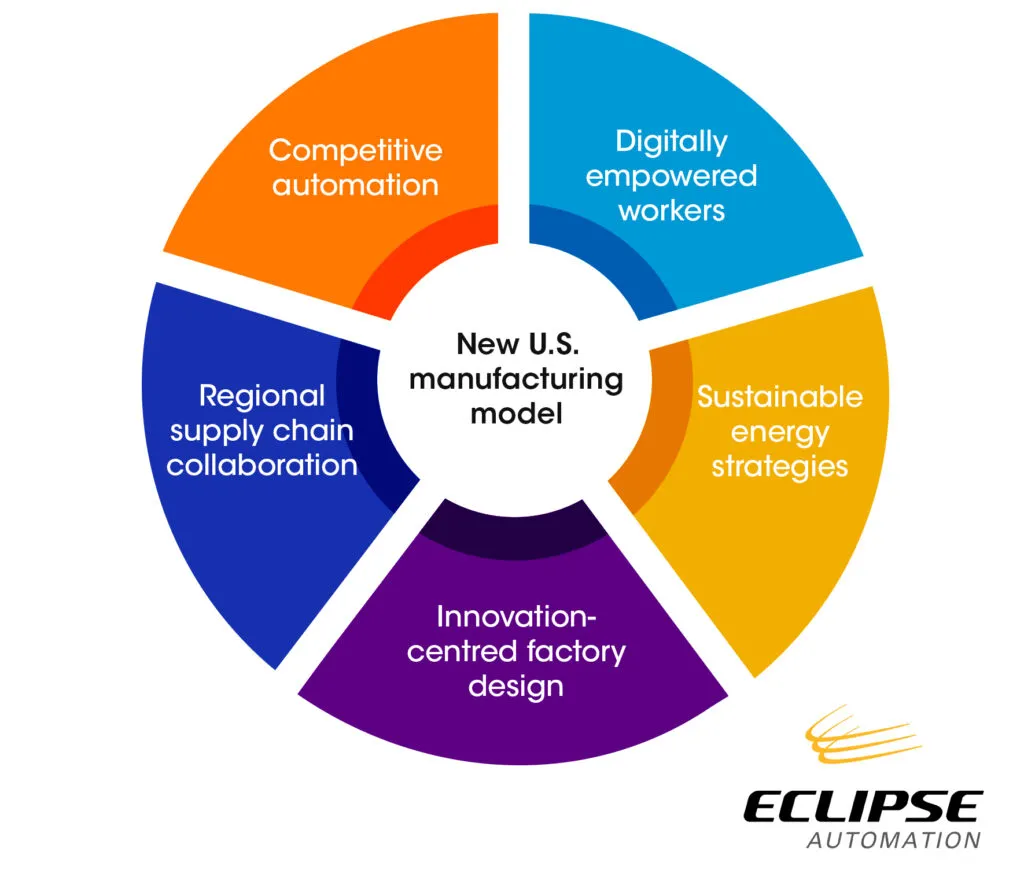
The new U.S. manufacturing model
What’s happening in U.S. manufacturing is not a return to the past. It’s the emergence of a modern ecosystem built around resilience and innovation. These characteristics are quickly becoming the new standard for global competitiveness.
- Competitive automation
- Digitally empowered workers
- Sustainable energy strategies
- Regional supply chain collaboration
- Innovation-centred factory design
The United States now can lead the world in advanced manufacturing—not by replicating old models, but by building smarter, more resilient systems from the ground up.
Eclipse Automation’s role in the reshoring movement
With decades of experience delivering complex automated systems across sectors, Eclipse Automation is uniquely positioned to support the transition back to U.S. manufacturing. Our expertise spans:
- EV battery and energy storage automation
- Medical device assembly and testing
- Nuclear component and isotope production systems
- Semiconductor and microelectronics manufacturing
- Flexible consumer goods and industrial assembly lines
- High-precision automotive and heavy machinery systems
From concept to commissioning, Eclipse provides a complete turnkey approach that accelerates ramp-up, reduces risk, and ensures sustainable long-term operation.
Six practical recommendations for leaders considering reshoring
If you’re evaluating reshoring, here are pragmatic steps we recommend:
- Start with the economics of the line, not the plant. Model total delivered cost per SKU at different automation levels (manual, semi-automated, fully automated) and includes inventory, lead time, and quality costs.
- Design for manufacturing flexibility. Choose modular cells and flexible tooling so lines can adapt to product changes without complete rebuilds.
- Pair automation with workforce planning. Define training paths, operator roles, and continuous learning so automation lifts the workforce and local economic value.
- Digitize early. Implement MES and data capture from day one — you can’t optimize what you don’t measure or see.
- Leverage public incentives thoughtfully. Federal and state programs can materially improve ROI — but design projects to meet eligibility and long-term operational needs, not just grant timelines. Reshoring Initiative data shows that policy is driving meaningful job announcements, but long-term success still depends on execution and competitiveness.
- Embed change management from the start. Treat digital manufacturing transformation as both technical and human. Align stakeholders early, communicate the “why,” and build champions at every level. Incorporate feedback loops, readiness assessments, and clear ownership so adoption sticks long after go-live.
Reshoring isn’t just about returning production. It’s about reimagining what’s possible. With automation as the engine, the U.S. can build the most advanced manufacturing ecosystem in the world.
Explore the possibilities
Looking to reshore operations or simply learn how automation can transform your factory? Contact us today to explore tailored solutions that drive efficiency, resilience, and growth.
Related articles and insights
-

Programming the future with Vanessa Loiola: Why robots give us time back
Programming robots means programming a better use of human time. Read More
-

Celebrating 25 years of Eclipse Automation and where factory automation is going
In 2026, Eclipse Automation marks 25 years of precision, performance, and partnership. Read More
