

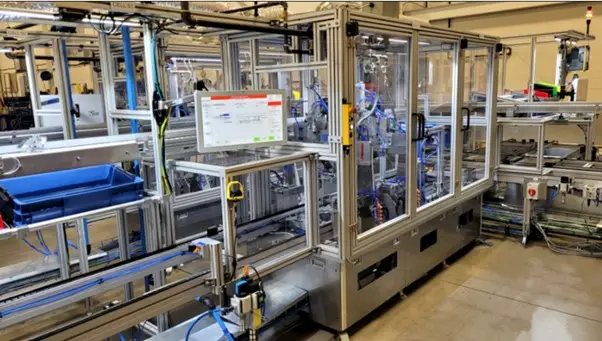



Industrial automation in life sciences manufacturing helps pharmaceutical, biotechnology, health food, supplement, and medical device companies improve product quality, increase throughput, reduce waste, strengthen traceability, and bring compliant products to market faster. For teams evaluating life sciences automation, it creates a stronger foundation for reliable, scalable production.
For manufacturers operating under strict quality and regulatory expectations, automation is no longer only a productivity tool. It is a way to build repeatable, data-rich, and scalable production systems that support safer products and better patient outcomes.
From pharmaceuticals and biotechnology to medical device manufacturing, automation helps teams meet growing demand, maintain compliance, and deliver consistent product quality across complex production environments. Medical device manufacturing automation is especially valuable when products require precise assembly, repeatable inspection, and strong documentation.
Life sciences manufacturers are using smart manufacturing, AI-enabled inspection, robotics, cleanroom automation, and Industry 4.0 technologies to optimize operations and improve production visibility. These systems support automated medical device assembly, sterile production, high-speed packaging, real-time monitoring, and flexible scale-up. The result is a manufacturing model that is precise, compliant, adaptable, and ready for evolving market needs.
Key Takeaways
- Industrial automation improves life sciences manufacturing by making production more consistent, traceable, efficient, and scalable.
- Automated systems increase throughput by reducing bottlenecks, supporting continuous production, and handling repetitive tasks with speed and accuracy.
- AI-powered inspection, vision systems, and precision assembly improve quality control and help reduce defects, scrap, and rework.
- Digital documentation, data logging, and traceability help support quality audits and regulatory compliance.
- Scalable automation makes it easier to adapt to new products, packaging formats, production volumes, and market requirements.
- Automated machinery can improve workplace safety by reducing direct human exposure to hazardous, sterile, repetitive, or ergonomically difficult tasks.
What are the benefits of industrial automation in life sciences and medical device manufacturing?
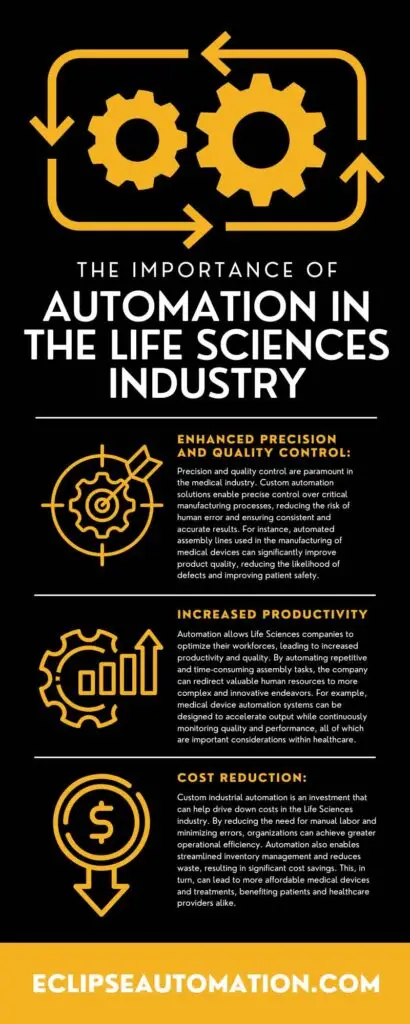
| Better precision and quality control | In medical device production, even small defects can have serious consequences. Medical device quality control automation supports high-precision assembly, measurement, and inspection. Integrated vision systems and AI-enabled inspection can detect issues in real time, helping every device meet quality, compliance, and patient safety expectations. |
| Higher throughput and productivity | Automated medical device assembly helps companies increase output without sacrificing quality. Repetitive and labor-intensive tasks (such as insertion, sealing, testing, labeling, and packaging) can be handled by high-speed systems so teams can focus on engineering, research and development, and product innovation. |
| Lower operating costs and less waste | Automation can reduce manual handling, improve material use, streamline inventory management, and minimize downtime. In medical equipment manufacturing automation, this can mean fewer errors, less scrap, fewer recalls, and better use of skilled labor. |
| Stronger regulatory compliance and traceability | Meeting international regulations and quality expectations, including FDA requirements and ISO 13485, is critical in medical device manufacturing. Automated systems can support traceability, data logging, digital documentation, and audit readiness. These capabilities are especially important for cleanroom automation for medical devices and other sterile or contamination-sensitive production environments. |
| Faster speed to market for medical innovation | Smart manufacturing solutions from Eclipse Automation can reduce lead times, improve production readiness, and support flexible scale-up. That helps manufacturers bring new treatments, diagnostic tools, wearable health technologies, and medical devices to market faster while maintaining quality and compliance. |
Real-world applications of automation in life sciences
Health food and supplement automation
As consumer demand rises, health food manufacturers are turning to automation to ensure accurate formulation, temperature control, and packaging. Our systems are easily adaptable to new ingredients and packaging formats, supporting evolving market demands.
Pharmaceutical manufacturing
Automation streamlines everything from tablet pressing to packaging and labeling, improving consistency and reducing contamination. This makes it easier to scale while ensuring safety and dosage accuracy.
Medical device automation
Automation enhances the precision medical device production required for critical instruments like insulin pens, diagnostic test kits, and surgical tools. Standardized assembly techniques, robotic inspection systems, medical device quality control automation, and predictive maintenance help every unit meet exact specifications.
Why automation matters now for life sciences manufacturers
The advantages of automation in life sciences are clear: better precision, higher throughput, lower waste, stronger compliance, and faster delivery. As digital transformation in medical device production accelerates, manufacturers need systems that can scale without compromising safety or quality.
At Eclipse Automation, we help organizations unlock new levels of performance through industrial automation that is intelligent, compliant, and future-ready. Custom automation for medical industry devices can support precision medicine, personalized healthcare, and improved patient outcomes.
When technology and human expertise work together, life sciences manufacturers can build more resilient production systems and make a stronger impact on global health.
Article updated July 2026.
FAQs
Frequently asked questions
What is industrial automation in life sciences manufacturing?
Industrial automation in life sciences manufacturing uses robotics, controls, vision systems, data systems, and intelligent equipment to perform production, inspection, packaging, and documentation tasks with repeatable precision.
How does automation improve medical device manufacturing?
Automation improves medical device manufacturing by increasing assembly accuracy, reducing manual variation, supporting in-line inspection, capturing production data, and making it easier to scale output while maintaining quality.
Can automation support FDA and ISO 13485 compliance?
Yes. Automation can support compliance by enabling traceable processes, controlled documentation, real-time monitoring, repeatable quality checks, and production records that help manufacturers prepare for audits and regulatory reviews.
What life sciences processes can be automated?
Common automation opportunities include medical device assembly, pharmaceutical packaging, cleanroom handling, diagnostic kit production, supplement packaging, labeling, inspection, testing, data logging, and material handling.
When should a manufacturer invest in custom automation?
A manufacturer should consider custom automation when demand is increasing, quality variation is costly, manual processes limit throughput, documentation requirements are growing, or a product needs a scalable production path from pilot build to full manufacturing.
How can automation help reduce contamination risk in life sciences production?
Automation can reduce contamination risk by limiting manual handling, supporting cleanroom automation for medical devices, improving repeatability, and enabling consistent inspection, cleaning, filling, sealing, and packaging steps.
What role does data play in medical device manufacturing automation?
Production data helps manufacturers monitor performance, verify quality, identify trends, improve traceability, support predictive maintenance, and make faster decisions across automated medical device manufacturing lines.
How does automation support scalable production?
Automation supports scalable production by creating repeatable processes that can move from pilot builds to higher-volume manufacturing, while maintaining quality, documentation, and process control as demand increases.
Explore the possibilities
Book a no-hassle pre-automation discussion to explore how custom life sciences automation can improve quality, compliance, throughput, and scalable production.
Related articles and insights
-

How to select a GMP-compliant automation integrator
Selecting GMP-compliant automation integrators for life sciences manufacturing Read More
-

The next wave of industrial evolution with Jeff Winter | Introducing People B4 Machines podcast
The People B4 Machines podcast demystifies automation, aligning strategy, tech, and culture. Read More
