

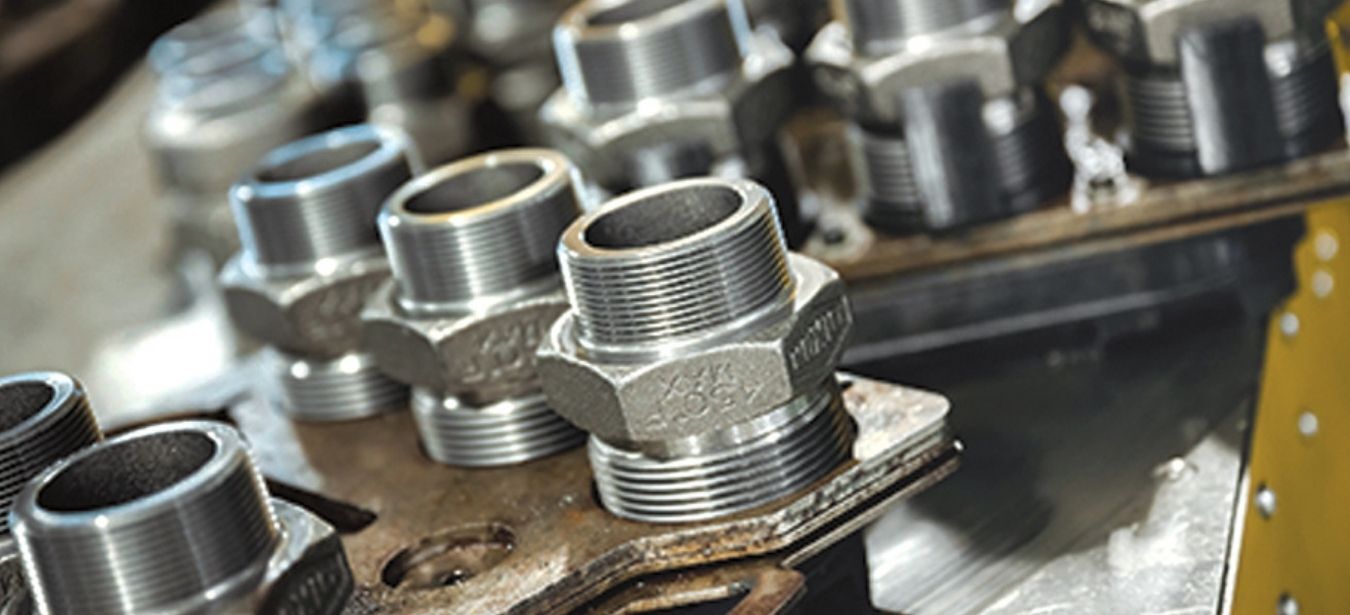


Surviving in commoditized markets, using automation to boost efficiency, flexibility, and responsiveness
The global industrial valve market is valued at USD $76.2 billion and is projected to grow at 4.4% CAGR by 2030. The market is driven by several factors including new power plants and increased investment in industrial equipment. However, global industry has become increasingly competitive with many companies manufacturing products to ISO standards in Asia, benefiting from lower input costs.
Dixon Valve is one of the few American valve manufacturers in the market; however, the manufacturing equipment for male valves was nearing end of life. This prompted the company to transform its manufacturing processes to yield greater efficiency to maintain its competitive edge and increase its market share in the coming decade and beyond.
- Highly commoditized global market
- 2 products from 1 production line
- Halving production, doubling capacity
A trusted source for important decisions
Dixon identified a growth opportunity in the OEM (Original Equipment Manufacturer) market. However, to capitalize on this opportunity it faced several challenges, this included older equipment nearing end of life, causing frequent downtime and inefficiencies, while the ability to attract skilled labor was also influential.
Dixon’s male valve line, a highly commoditized product, faced stiff competition where all players offer ISO-certified products. The lack of differentiation meant that gaining a competitive edge would require significant improvements in operational efficiency, in addition to promoting its American roots and high-quality products. When exploring automation options for upgrading the production line, there were many technologies available. Dixon had not invested in manufacturing equipment for several years, and with the fast advancement of technology, the company benefited from our thorough review of the options, evaluating the technologies on several consistent criteria including quality, cost, and after sales support.
Eclipse Automation uses a unique methodology for our projects consisting of four stages: Evaluate, Plan, Activate, and Maintain. These phases start with an overall evaluation of the customer needs, existing processes and need, then looking into engineering, safety and other standards to plan an effective solution. It then moves into actioning the plan and ensuring that it is maintained to be resilient for years to come. Together, these stages help us enhance safety, efficiency, agility, and innovation.
When providing insight into the different technologies on the market, we leverage our knowledge and insight from previous projects and provide an unbiased opinion to allow our clients to make informed decisions regarding the components and technologies to be included in the manufacturing line.
Collaborative solution development
At Eclipse Automation, we prioritize close collaboration with our clients to deeply understand their needs and challenges. Our highly skilled team of engineers, trade professionals, and automation experts work meticulously to analyze key data such as cycle-time charts, product specifications, industry standards and manufacturing processes.
Through a discovery process, we identified an opportunity to further streamline and optimize operations for Dixon. We proposed a new automated production line capable of producing both male and female valves. While this required some modifications and updated tooling and a divergence from existing processes, the long-term benefits would be substantial.
“We prioritize close collaboration with our clients to deeply understand their needs and challenges.”
Dixon previously operated two separate production lines, one for male and one for female valves. While the female manufacturing line did not need immediate replacement, the convergence onto one line would maximize efficiency. In addition, the one line would eliminate any redundancy and reduce overall operating costs, increase flexibility by allowing the line to switch between male and female valves based on demand, while also boosting ROI and reducing the need for investment in the second line in the future.
Simplifying the complexity of valve manufacturing
While valves may seem to be a relatively simple component, the solution was far from straightforward. The system was engineered to handle the production of more than 20 different part types, adding significant variability to the production process and required careful consideration and precise engineering to ensure the system could effectively handle the wide range of parts.
In addition, the material itself presented challenges. Made of metal, the valves were shiny and contained small components making it difficult for vision systems to effectively detect. Vision systems are typically used to support bin picking applications, but their performance can be hindered by reflective or shiny surfaces and smaller parts, making it harder for the machine to scan and identify all the components correctly. Leveraging our extensive expertise in vision systems and complex automation projects, our team was able to engineer a custom solution to maximize the effectiveness of bin picking.
The holistic approach we took to the manufacturing process also integrated many feeding techniques into the manufacturing process, including ball feeders, 2D flex feeders and more. The ability to seamlessly integrate these functions led to significant time saving, decreased downtime, while maintaining high quality products, achieving a strategic and competitive advantage.
The outcomes
The investment in new automation technology significantly enhanced Dixon’s ability to compete in the highly competitive valve market. With rising pressure from lower cost providers, it was important to use automation to maintain its position as the leading North American manufacturer on the market.
By implementing the new manufacturing line, Dixon was able to realize game-changing improvements in throughput and production volume. The new system enabled the company to produce the same quantity of valves in half the time, effectively allowing it to double capacity. This efficiency will support Dixon’s ambition to increase its market share and meet future customer demand.
Furthermore, the flexibility of the new system allowed for the interchangeable manufacturing of male and female values and their associated components, allowing for greater agility to adapt to any change in market demand. This presents a significant strategic advantage and allows for Dixon to seamlessly streamline production and ultimately safeguard its position as a reliable North American manufacturer of high-quality valves.
