

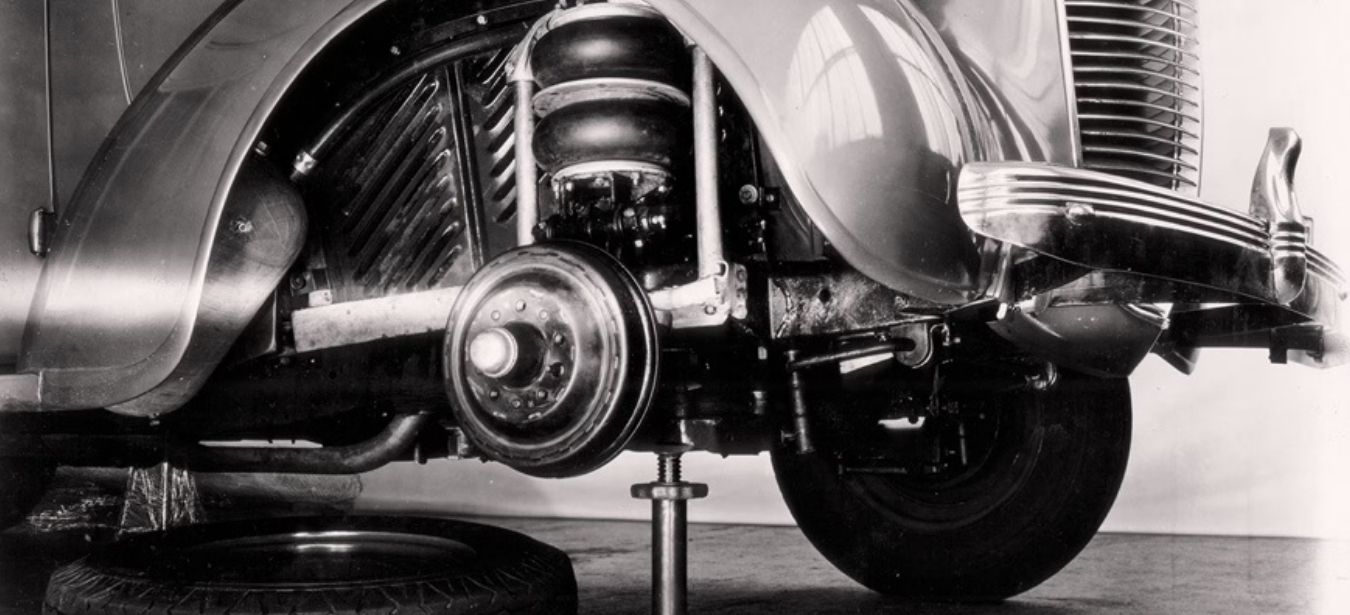


The original air spring just made a step change
The global air spring market is experiencing significant growth, driven by the increasing adoption of electric vehicles, the introduction of new vehicle models and, in Asia, the growing demand for vehicles in general.
Currently valued at USD $6.6 billion, the market is projected to expand at a compound annual growth rate (CAGR) of 7%, with estimates suggesting it could reach between USD $13.9 billion and USD $26.5 billion by 2030, depending on regional trends and advancements in technology. Key markets include regions with major automotive manufacturers, particularly North America and Europe. In North America, air suspension systems are being increasingly integrated into both passenger and commercial vehicles.
Firestone has benefited from this growth, having a strong record in manufacturing air springs. The company secured a flagship, multi-year contract to supply millions of air springs to a premium automotive company. However, the scale of this project was significantly larger and demanded a scalable, high-performance solution capable of maintaining consistent quality and efficiency across North America, and potentially, Europe.
To ensure project success, it was critical to partner with an automation provider experienced in the automotive sector, one that could fully understand the intricacies of air spring manufacturing and deliver a flexible, future-ready solution.
- 7 robots performing 11 tasks
- Cycle time under 40 seconds
- 75% Overall Equipment Effectiveness (OEE)
Creating new paths forward
At Eclipse Automation, we take a collaborative approach to understanding our clients’ needs. For this project, we engaged Firestone for over several months to gain a deep understanding of their manufacturing processes and key pain points.
Our teams brought a balanced mix of technical, engineering, and applied knowledge to the project, complementing Firestone’s highly skilled team who worked on previous air suspension projects. By collaborating, we ensured each solution was practical and effective for the client’s requirements, while also being technically sound.
Our advanced engineering services apply a proven methodology to the early stage of the project. From there, we identify the right solution by engaging relevant experts before going on to develop a transition plan from existing processes to a more automated system. We can also evaluate future production scaling and incorporate validation and control measures to align with the client’s strategic goals.
During the planning phase, our technical experts conducted on-site visits with the client to observe and analyze the current manufacturing environment. This included detailed walkthroughs of existing processes and documentation of any unique technical specifications. This first-hand insight, and collaboration with Firestone, enabled us to understand the required inputs and processes which were then reflected in the design of a custom automation solution that fully addressed all project specifications and requirements.
“Our teams brought a balanced mix of technical, engineering, and applied knowledge to the project, complementing Firestone’s highly skilled team.”
Collaboration with third-party technology providers, specifically for crimping and leak testing, was important to ensure seamless integration within the new production line. By leveraging our decades of automation experience, our team was able to provide objective recommendations that supported the client in selecting the most effective technologies to integrate into the line.
We developed a conceptual framework that integrated core elements of Firestone’s existing processes while adding the necessary automation technologies to meet the project’s goals.
This included the use of robotics for flexible movement and multi-task functionality, as well as the integration of various feeding systems, including ball feeders, flex feeders, dampers, and rotary feeders, all tailored to the unique requirements of the production line.
Embrace the art of the impossible
The air spring assembly was particularly delicate and required precise, controlled movements to correctly install individual components. The robot system had to perform multiple tasks, with the leak test process expanded from two to three chambers to ensure higher reliability and performance.
The conceptual framework incorporated components of existing processes, while having sufficient technology in place to meet the complex project needs. Understanding the process flow played a critical role in the project’s success. The seven robots had to work in coordination to manage material handling across various automated stations. In total, the robots were responsible for executing 11 distinct automation operations, including damper and gaiter assembly, torquing, part feeding, material handling, and visual inspection. The team had to carefully program and optimize each stage of the automation sequence to ensure smooth integration and reliable performance, all while managing the unique physical sensitivities of the air spring.
To support planning and communications, we leveraged Nvidia’s Omniverse to create a system. This immersive visual representation offered clear insights into each stage of the manufacturing process, enabling both our internal teams and Firestone to fully understand the solution’s capabilities before implementation.
The outcomes
In the end, the fully automated line successfully and efficiently assembled the air spring suspension system, achieving a cycle time of under 40 seconds. This allowed Firestone to reach a production capacity of 400,000 units annually with an impressive 75% Overall Equipment Effectiveness (OEE).
To support validation prior to plant installation, we coordinated with Firestone to use floorspace at our facility for on-site validation runs. Operators and Firestone’s representatives were brought in to run pre-installation validation parts, ensuring readiness and reducing risk. These successful proofs of concept (POCs) were a direct result of early collaboration and proactive risk mitigation in the automation design phase.
The Factory Acceptance Testing (FAT) was conducted at our facility, where we provided extended access to the production line. This allowed Firestone, and their end-customer to produce and test prototype parts for validation in actual vehicles. This early, real-world experience ensured both parties were fully satisfied with the system’s performance.
Once validation was complete, the line was shipped and installed at Firestone’s site under Eclipse’s supervision. We provided on-site support and operator training to ensure smooth ramp-up and confident handoff. Importantly, the system was built with scalability in mind, ready to grow alongside Firestone’s North American operations and even support future expansion into European markets.
The project was delivered on schedule and met all performance, quality, and delivery expectations from Eclipse Automation and Firestone.
