

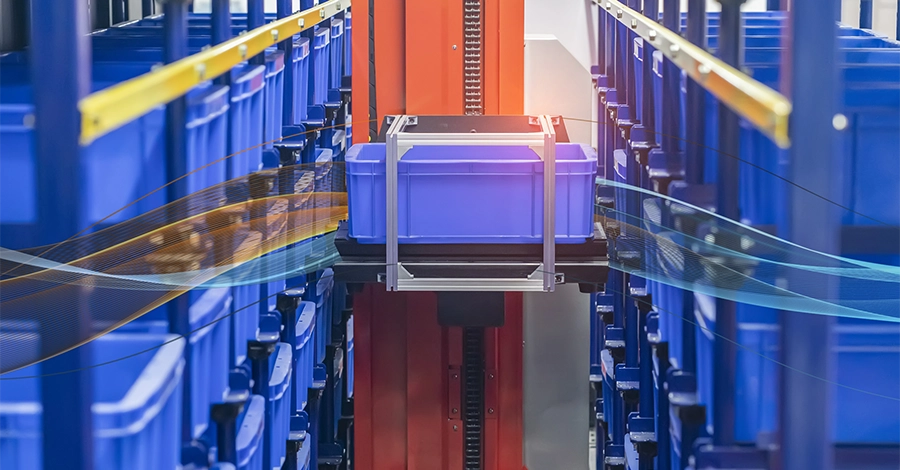


When people think of warehouse automation, they often picture robotic arms or conveyor belts. But some of the most dramatic efficiency gains are happening in Automated Storage and Retrieval Systems (ASRS).
These automated warehousing systems are quietly transforming how companies handle inventory and the results are nothing short of remarkable.
Unlike traditional shelving with human pickers and forklifts, ASRS uses cranes, shuttles, or robots to store and retrieve inventory from dense rack structures. The technology has matured rapidly in recent years, with ASRS solutions able to reclaim up to 85% of warehouse space and cut labor costs by around 60% compared to manual shelving, while achieving near-perfect order accuracy.
Key takeaways
- Automated storage and retrieval systems technology enables dramatic space savings and labor cost reductions while achieving near-100% order accuracy.
- Leading companies like Amazon, Kroger, and Toyota are achieving significant ROI through integrated ASRS deployments.
- Integration with AI, vision systems, and AGVs is creating “goods-to-person” workflows that minimize worker travel and fatigue.
- Adoption is accelerating globally, with North America leading at 41% market share but Asia-Pacific showing the fastest growth.
Real-world results driving rapid adoption
The business case for ASRS becomes clear when you look at actual deployments. Footwear brand Ariat installed Exotec’s Skypod ASRS and delivered a 10x jump in picking speed, letting 80% of former pickers move to higher-value work like quality control. Meanwhile, Kroger’s eight Ocado-powered automated customer fulfillment centers use grid-based ASRS robots and conveyors to pick thousands of grocery items, with Kroger reporting industry-leading fill rates and customer satisfaction.
These aren’t isolated success stories. Amazon alone operates over 11,000 “smart” warehouses and deployed 750,000 robots by 2023 (up 40% year-over-year). The technology has also proven particularly valuable in challenging environments: a Tennessee ice-cream warehouse, for example, uses a deep-freeze ASRS with two crane units and two automated guided vehicles (AGVs) to keep production continuous through the night and winter by automatically moving pallets in -25°C environments without human exposure.

Integration is the key differentiator
What sets modern ASRS apart isn’t just the storage technology itself, but how it integrates with other automation systems. ASRS units work alongside AGVs and autonomous mobile robots (AMRs) to move products from receiving to storage and out for shipping, creating seamless workflows that eliminate manual handoffs and reduce errors.
The integration with AI and vision systems is particularly transformative. Advanced picking systems use cameras and ML to recognize items and adjust grips on the fly, while Amazon’s “Sparrow” robotic arm employs computer vision to identify and sort individual products without fixed location data. This enables true “goods-to-person” workflows where items are automatically brought to ergonomically designed pick-and-pack stations, minimizing worker travel and fatigue.
Even in manufacturing, the integration benefits are clear. At a UK assembly plant, Toyota replaced human-driven tugs with MasterMover AGVs that shuttle heavy car-body parts. The AGVs achieved ROI within two years and improved productivity by automating wasteful transfers, allowing operators to focus on assembly tasks. Toyota was so impressed that they now plan a global rollout of these AGVs.
Market momentum building globally
Adoption of ASRS is accelerating worldwide, though there’s still significant room for growth. ASRS penetration in warehouses is still modest (15-20%), indicating massive potential for expansion. North America currently leads ASRS usage, holding ~41% of the global ASRS market, driven largely by major retailers rapidly implementing automation to address labor shortages and rising customer expectations.
Asia-Pacific is the fastest-growing region with roughly 47% growth recently, led by China (over half of APAC’s ASRS market), Japan, and India. Chinese manufacturers and e-commerce giants like Alibaba and JD.com are installing ASRS and AMRs to meet surging demand, while surveys show 52% of warehouse managers plan to increase robotics spending.
The technology is proving valuable across diverse sectors. Retail and e-commerce represents about 29% of ASRS market share, but automotive and heavy industry also use ASRS heavily for just-in-time parts management. Even specialized applications are emerging: automated pharmacies use ASRS to track lot numbers, expiration dates, and enforce FIFO, drastically cutting dispensing errors.
Tomorrow’s smart warehouse: Smaller, faster, fully lights-out
Looking ahead, ASRS technology is advancing toward even greater intelligence and connectivity. Future ASRS shuttles and cranes will likely have built-in ML for dynamic slotting and on-the-fly order batching, while cloud-based warehouse and order management systems (WMS/OMS) are evolving into end-to-end platforms that orchestrate ASRS, conveyors, drones and vehicles as a unified fleet.
The ultimate vision is a fully autonomous warehouse where human workers focus on high-value tasks while automated systems handle routine storage and retrieval. As one Toyota engineer noted about their AGV implementation, these systems “unlock greater efficiency and reduce waste,” ultimately allowing human workers to focus on higher-value tasks.
For manufacturers considering ASRS implementation, the message is clear: this technology has moved beyond experimental to essential. With proven ROI, mature integration capabilities, and accelerating adoption across industries, ASRS represents a critical foundation for competitive advantage in an increasingly automated future.
Watch the vlog
Explore the possibilities
Curious to see how ASRS technology can integrate with your existing systems to create an ideal industrial automation solution? See how Eclipse can help you design and deploy an ASRS solution custom tailored to your operational needs.
Related articles and insights
-

Automating manufacturing across the value chain: Beyond the robot arm
Automation is expanding from production to logistics, warehousing, and distribution.
-

Global manufacturing: How manufacturing automation strategies vary across regions
Eclipse works with clients worldwide to observe how regional factors shape automation.
