

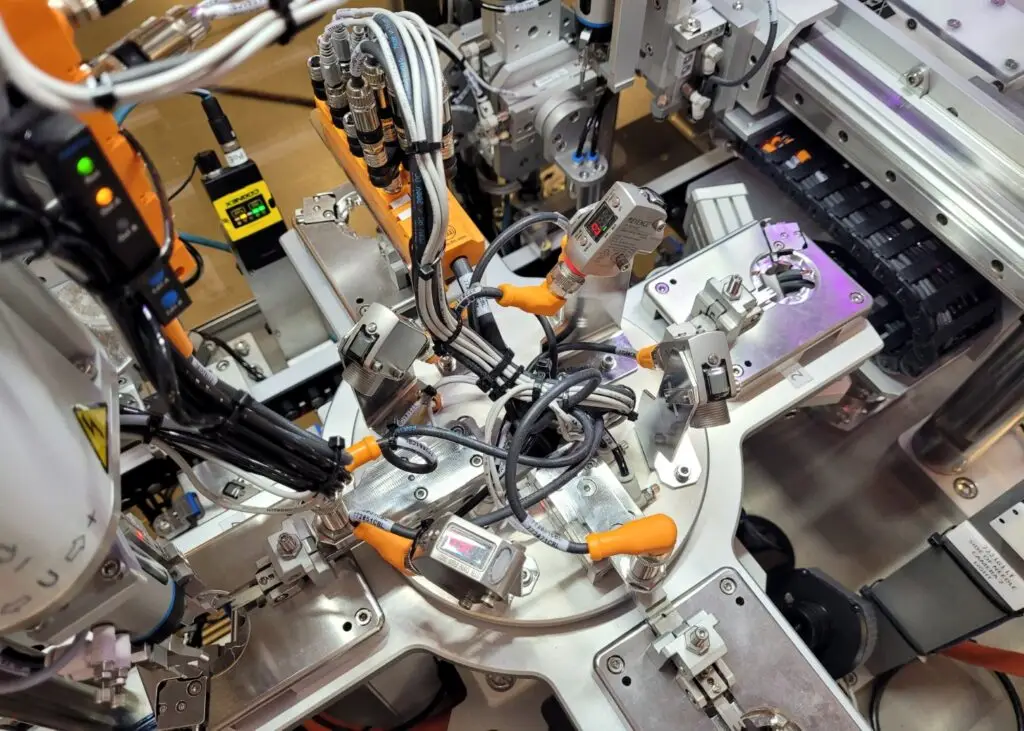


Medical device manufacturing automation is the use of industrial robotics, machine vision, and connected data systems (MES, SCADA, industrial IoT) to assemble, inspect, and document medical devices with less human intervention.
Manufacturers invest in it now because it delivers three things manual production cannot: Sub-millimeter precision, real-time regulatory traceability, and 30 to 50 percent less unplanned downtime through predictive maintenance.
Medical device manufacturers are caught between two pressures that keep building at the same time. Regulatory scrutiny under FDA, ISO 13485, and CE frameworks keeps tightening, while margins keep shrinking under labor shortages and rising material costs. A single missed tolerance can trigger a recall, and unplanned downtime on a production line can cost more per hour than the automation equipment itself.
Operations, engineering, and procurement leaders need a way to close both gaps at once. Medical device manufacturing automation, built around industrial robotics, machine vision, and connected manufacturing execution systems, gives plant leaders the precision, traceability, and uptime that manual lines cannot deliver at scale.
Key Takeaways
- Medical device manufacturing automation reduces variability and human error in precision assembly, supporting compliance with FDA, ISO 13485, and CE requirements.
- Predictive maintenance and connected MES/SCADA systems can cut unplanned downtime by 30 to 50 percent, according to McKinsey research.
- Machine vision and industrial robotics accelerate time to market while maintaining the documentation regulators require.
- Automation investment carries real upfront costs, but manufacturers typically recover them through lower labor costs, reduced scrap, and higher uptime.
- Flexible, modular automation lines let manufacturers scale new devices and product variants without rebuilding entire production systems.
Why does automation matter for medical device manufacturing today?
Automation matters now because regulatory and cost pressure are both accelerating at the same time, and manual production cannot scale to meet either.
The pressure to modernize is no longer optional for medtech leaders. In Deloitte’s 2026 Life Sciences Outlook, nearly half of medtech and biopharma executives named accelerated digital transformation as a trend expected to substantially affect their operations this year, and 47 percent of medtech leaders said AI-enabled automation will be their primary strategy for controlling costs.
At the same time, medical robot sales grew 91 percent in a single year, according to the International Federation of Robotics, with diagnostics and lab analysis robots up 610 percent. The direction is clear: manufacturers who delay factory automation are competing against peers who are already scaling it.
How does automation improve precision and consistency?
Precision is not a nice-to-have in medical device production; it’s a patient safety requirement. Industrial robotics and machine vision systems assemble and inspect components with sub-millimeter accuracy, catching defects that manual visual inspection would miss. This consistency compounds over time.
As industrial robot installations approach 4.7 million units in active use worldwide, according to the IFR World Robotics 2025 report, manufacturers across regulated industries are proving that automated precision scales without sacrificing repeatability.
How much faster can automated lines bring devices to market?
Automated lines produce at rates manual processes can’t match, whether the goal is high-volume output or rapid prototyping for a new device variant. That speed matters most during periods of surging demand, when manual capacity simply runs out, but it also depends on choosing the right automation technologies for the specific production bottleneck.
Automated validation and testing processes can also shorten certification timelines significantly, helping manufacturers close the gap between production readiness and regulatory sign-off.
In practice, the biggest gains usually come from combining physical automation, real-time inspection, and connected production data rather than treating each system as a standalone upgrade. The table below shows where each technology creates value and how that value translates into faster, more reliable commercialization.
| Technology | Primary function | Business outcome |
| Industrial robotics | High-precision assembly and material handling | Fewer defects, consistent cycle times |
| Machine vision | Real-time inspection and defect detection | Reduced scrap, stronger audit trails |
| Predictive maintenance | Sensor-based equipment monitoring | 30 to 50 percent less unplanned downtime |
| MES and SCADA integration | Production data capture and control | Real-time traceability, faster audits |
| Digital twins | Virtual process simulation and validation | Lower validation costs before physical builds |
| Industrial IoT | Connected sensors across the line | Centralized data for quality and compliance reporting |
What does automation cost, and what is the actual return?
Automation requires real upfront investment, but predictive maintenance alone typically returns 30 to 50 percent less downtime and 20 to 40 percent longer equipment life. It requires real upfront investment, and manufacturers should plan for that honestly rather than treating it as a minor line item.
The return shows up over time through lower labor costs, reduced downtime, and better resource utilization. McKinsey’s analysis of predictive maintenance found that predictive maintenance programs typically reduce machine downtime by 30 to 50 percent and extend equipment life by 20 to 40 percent, savings that compound across a plant running multiple lines.
Manufacturers that phase automation in, starting with the highest-friction process step, tend to reach payback faster than those attempting a full line replacement at once.
Article updated July 2026
FAQs
Frequently asked questions
What is medical device manufacturing automation?
Medical device manufacturing automation uses robotics, machine vision, sensors, and production software to assemble, inspect, test, and document medical devices with less manual intervention. It helps manufacturers improve precision, reduce variation, and create the production records needed for regulated environments.
Does automation help with FDA and ISO 13485 compliance?
Yes. Automated systems can support FDA and ISO 13485 compliance by capturing process data, improving traceability, standardizing inspection steps, and reducing manual documentation errors. They do not replace regulatory controls, but they make audit readiness easier to maintain.
How much does automating a medical device production line cost?
Costs depend on the device, process complexity, validation needs, and whether the project is a phased upgrade or full line build. The strongest business case usually starts with the process step creating the most scrap, downtime, inspection burden, or documentation risk.
What automation technologies create the most value in medical device production?
The highest-value technologies are typically industrial robotics, machine vision, predictive maintenance, MES and SCADA integration, industrial IoT, and digital twins. Together, these systems improve precision, quality control, traceability, uptime, and validation planning.
How long does it take to see ROI from medical device automation?
ROI timelines vary by project scope, production volume, and current line performance. Manufacturers that phase in automation, starting with inspection, predictive maintenance, or another high-friction process step, often see measurable reductions in downtime, scrap, and manual effort sooner than teams that attempt a full line replacement at once.
Explore the possibilities
Ready to see where automation could reduce risk and cost on your production line? Book a discovery call to learn how Eclipse Automation supports medical device manufacturing automation solutions.
Related articles and insights
-

How smart traceability can boost efficiency and fix problems before they happen
Modern traceability digitally links components across every stage of assembly. Read More
-

How automated testing gives companies an edge in medical device manufacturing
Manual validation is slowing time-to-market despite automated medical manufacturing. Read More
