

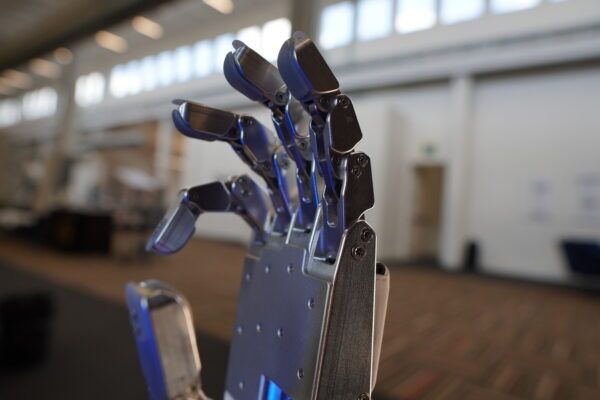


Humanoid robotics—the design and deployment of machines that mimic human form and movement—is no longer the stuff of science fiction.
These robots are now stepping into real-world industries, bringing intelligence and adaptability to environments where traditional automation often struggles.
At Eclipse Automation, we believe that the next generation of industrial automation will include humanoid robots as valuable team members on the factory floor. That’s why we’ve partnered with Mirsee, one of Canada’s leading humanoid robotics companies, to accelerate the development and deployment of these intelligent machines.
Together, we’re building toward a future where humanoids fill critical gaps in labor and productivity by assisting with repetitive or hazardous tasks.
Key Takeaways
- Humanoid robots are entering real-world industries to handle tasks traditional automation can’t, especially in manufacturing and logistics.
- Mirsee focuses on creating practical, scalable humanoid robots that solve real problems like repetitive, dangerous, or physically taxing work.
- Eclipse Automation brings engineering and deployment expertise, helping accelerate the development and integration of Mirsee’s humanoid systems.
- Robots are designed to support humans, improving safety, productivity, and job satisfaction by taking over undesirable tasks.

Mirsee: A journey of practical innovation
Mirsee was founded seven years ago with a clear goal: to solve real-world problems through embodied AI. The idea began in healthcare and senior care settings, where daily tasks are often repetitive, labor-intensive, and physically taxing. This led to focus on embodied AI, where artificial intelligence is given a physical, human-like form to perform tasks in unstructured, dynamic environments.
“What drove us then still drives us now,” says Tarek Rahim, CEO of Mirsee. “We’re not just building cool tech. We’re solving real problems with mature, scalable solutions. We’re focused on offloading the dull, dangerous, and demanding work humans shouldn’t have to do.”
Since then, Mirsee has built three robot generations, refining its full-stack platform for real-world utility. The latest model, MH3, is a practical solution designed for adaptability and long-term value. It crosses a critical threshold where businesses can now realistically consider adding humanoids to their teams as these humanoid robots can handle a wide range of industrial tasks with minimal supervision. Each new generation delivers tangible improvements rooted in real-world performance.
This generation is no longer just about innovation for the sake of innovation; it is something that delivers measurable value for industrial customers in warehouses and elsewhere.


Why humanoid robots make sense now… And what comes next
While full general-purpose humanoids are still a few years away, there are already highly practical use cases emerging across manufacturing and logistics. Tasks like bin picking, tote moving, and material handling require a level of adaptability and spatial understanding that traditional fixed automation struggles to deliver.
In structured environments, traditional automation performs well. But real-world factories are not always predictable. With objects scattered in unpredictable ways, most robotic systems struggle to adapt.
“A humanoid robot can self-correct when it makes a mistake. It can adapt to changes in the environment without needing a full system redesign,” explains Rahim. “That’s what makes them powerful. You don’t need to rebuild your process to fit the robot. The robot fits into your process.”
Humanoids are built to handle this kind of real-world unpredictability. They can navigate unstructured spaces, recognize and manipulate irregularly placed objects, and make decisions in real time. For many businesses, this adaptability can lead to reduced downtime, increased safety, and faster returns on investment—without requiring a complete overhaul of existing operations.
For companies exploring their first use of humanoids, the best starting point is with repetitive, high-volume tasks. These roles are ideal for pilot programs, offering a clear path to value while building internal familiarity with humanoid systems.
Looking ahead, Mirsee expects to see humanoid robots deployed in warehouses and manufacturing facilities by 2027. Within the following three to five years, adoption will likely expand into commercial environments. And within the next decade, applications could extend to retail, offices, and even homes.
Crucially, this shift is not about replacing human workers. It’s about transforming work for the better.
“We’re very selective about the roles we automate,” says Rahim. “We’re focused on the roles people don’t want, the jobs that are exhausting, dangerous, or monotonous.”
This focus on practical value has also shaped some of Mirsee’s most important design decisions. One of the company’s most defining moments came when it chose not to pursue legged robots, despite industry trends. Although visually impressive, legged humanoid robots introduced more complexity, instability, and energy consumption without meaningful gains in performance or safety.
“We prioritized real-world reliability over flashy design,” says Rahim. “That’s what matters most to our customers.”
Mirsee and Eclipse: Building the future, together
Eclipse Automation brings decades of expertise in designing and integrating custom automation systems for some of the world’s most complex industries. That experience aligns naturally with Mirsee’s innovative approach to humanoid robotics, where the goal is not just to build advanced machines, but to make them truly useful in real-world environments.
This collaboration is already unlocking new opportunities. Mirsee gains access to Eclipse’s advanced hardware capabilities, deep manufacturing knowledge, and robust digital infrastructure. With support from Eclipse, Mirsee is also leveraging platforms like the Omniverse, which allows them to simulate robotic behavior, train AI models, and test systems in digital environments before physical deployment. These tools are essential in developing humanoids that are both intelligent and reliable.
As artificial intelligence continues to advance at an unprecedented rate, so do the capabilities of humanoid robots. Mirsee envisions a near future where these machines will understand their environment, follow complex instructions, and make autonomous decisions with minimal supervision. The goal is not just to build robots that can complete tasks, but to create systems that can work safely and effectively alongside people.
At the core of this collaboration is a shared belief: humanoid robots should support people, not replace them. Automation should address tasks that are unpleasant, unsafe, or unsustainable for humans to do long term. And it should be implemented in ways that improve how people work — not reduce their role in the workplace.
With Mirsee’s practical vision and Eclipse’s systems expertise, the future of humanoid robotics is not a concept. It is being built, tested, and deployed right now, and it is designed to make work safer, smarter, and more human-centered for everyone.
Explore the possibilities
Interested in how humanoid robotics and other automation technologies can fit into your operations? See how Eclipse Automation can help you design and deploy a practical solution tailored to your real-world challenges, whether you’re starting small or scaling up.
Related articles and insights
-

6 things to know about robotics and AGV providers
Manufacturers evaluating robotics and AGV providers need criteria beyond price and catalog specs. This guide covers… Read More
-
Why enterprise robotics, AMRs, and AGV systems are now an enterprise systems problem
Enterprise robotics, AMRs and AGV systems create value at scale when organizations treat automation as an… Read More
