

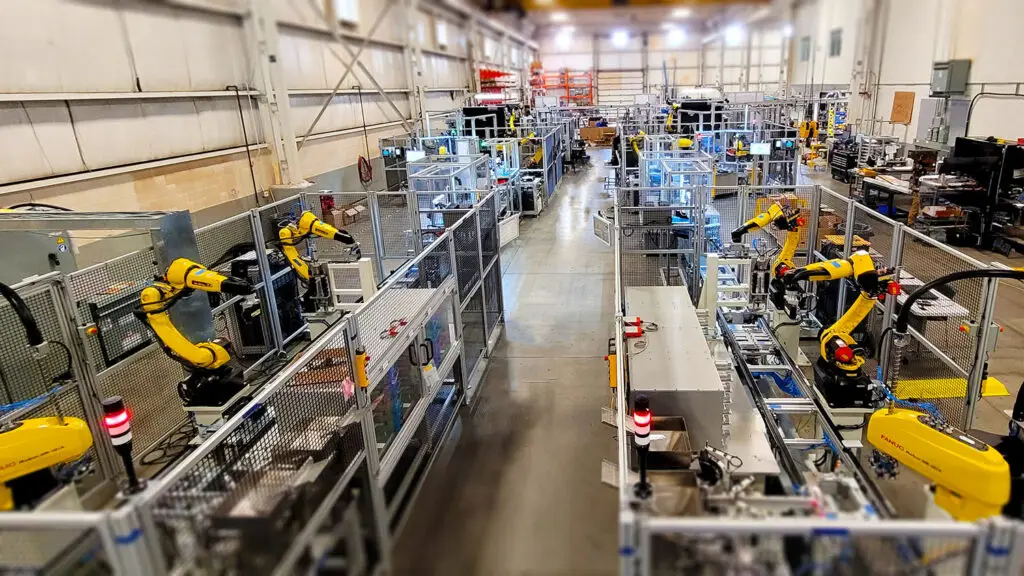



As industrial automation technologies rapidly evolve, more manufacturers are recognizing the power of automation to drive efficiency, quality, and competitiveness. In the context of Industry 4.0 and smart manufacturing, automation is no longer just a tactical upgrade — it’s a strategic transformation.
However, automating a manufacturing facility is a major undertaking that requires careful planning. Before diving in, it’s essential to evaluate key factors to ensure your investment aligns with your business goals. Here are the most important considerations before starting your automation journey.
Key Takeaways
- Start with a clear cost-benefit analysis that connects automation investment to productivity, quality, downtime reduction, and long-term ROI.
- Focus industrial automation on repetitive, error-prone, high-volume, or precision-based processes where technology can create measurable value.
- Prioritize scalable and flexible systems that can adapt to product changes, market shifts, and future smart manufacturing needs.
- Plan for maintenance, technical support, spare parts, and system updates before automation becomes business-critical.
- Use AI in industrial automation where it supports predictive maintenance, workflow optimization, quality monitoring, and real-time decision-making.
- Treat automation as part of a broader Industry 4.0 and smart factory strategy, not just a one-time equipment upgrade.
Perform a cost-benefit analysis
The first step in any automation project is to assess the financial impact. Evaluate both short-term and long-term costs, including:
- Equipment purchase and installation
- Integration with existing systems
- Software and controls
- Ongoing maintenance and support
Compare these costs against projected benefits such as increased throughput, lower labor costs, improved product quality, and reduced downtime. A clear return on investment (ROI) model helps justify the transition to smart manufacturing and provides a practical baseline for choosing the most cost-effective and scalable approach.
Analyze your processes
Not every process needs to be automated — the key is knowing where automation adds the most value. Examine your workflows and identify tasks that are:
- Repetitive and time-consuming
- Prone to human error
- Requiring precision or high-volume output
These are prime candidates for industrial automation. A structured process review can help manufacturers pinpoint opportunities for optimization and ensure automation complements existing operations without unnecessary disruption.
Consider scalability and flexibility
In a world where product lifecycles are shorter and demand shifts rapidly, flexibility is critical. Before automating, ask:
- Will the system scale as your business grows?
- Can it handle multiple product types or customization?
- Is it modular enough to adapt to future upgrades?
Smart factories thrive on flexible, data-driven systems. The goal is to design automation that can adapt over time, helping protect the investment as customer needs, production volumes, and product requirements change.
Plan for maintenance and technical support
Even the most advanced automation systems require regular upkeep. Downtime can be costly, so having a reliable support system is essential. A strong maintenance and support plan should include:
- Ongoing technical support
- Preventative maintenance programs
- Spare parts and system updates
- Quick response times to minimize disruptions
The objective is to keep AI-powered industrial automation systems operating reliably, with minimal risk to production schedules and business continuity.
Automation can transform a manufacturing facility, but the strongest results come from informed planning, realistic timelines, and a clear understanding of where technology can create the most value.
Understand the role of AI in industrial automation
As automation evolves, so does the role of AI in industrial automation. AI-enabled systems can analyze sensor data in real time, predict maintenance needs, optimize workflows, and detect quality issues before they escalate. Integrating AI not only enhances efficiency but enables smarter, autonomous decision-making in your production environment.
For many manufacturers, the most effective approach is to incorporate AI where it makes the most sense — supporting smarter decisions, greater adaptability, and more resilient production environments. Automation can completely transform a manufacturing facility, but success depends on informed planning, reliable support, and scalable technology.
As Industry 4.0 adoption continues, manufacturers should evaluate automation opportunities through the full lifecycle: process analysis, solution design, implementation, maintenance, and ongoing optimization.
Article updated July 2026
FAQs
Frequently asked questions
What is AI in industrial automation?
AI in industrial automation refers to using machine learning, real-time data, sensors, and connected systems to help manufacturing equipment and processes make smarter decisions. It can support areas such as predictive maintenance, quality monitoring, workflow optimization, and production planning.
How does AI improve manufacturing efficiency?
AI can improve manufacturing efficiency by analyzing operational data, identifying bottlenecks, detecting quality issues earlier, and helping teams reduce unplanned downtime. When used strategically, it supports faster decisions and more consistent production performance.
What should manufacturers consider before automating a process?
Before automating, manufacturers should assess cost, ROI, process readiness, scalability, flexibility, maintenance needs, and how the project fits into a broader smart manufacturing or Industry 4.0 strategy.
Why is predictive maintenance important in smart factories?
Predictive maintenance uses data and analytics to identify potential equipment issues before they cause downtime. This helps smart factories plan service more effectively, protect production schedules, and extend the life of critical assets.
How does industrial automation support Industry 4.0?
Industrial automation supports Industry 4.0 by connecting equipment, data, software, and people across the production environment. This creates the foundation for smarter factories that can monitor performance, adapt to change, and improve over time.
Explore the possibilities
Use these five considerations to start a practical conversation about where AI, scalable systems, predictive maintenance, and smart manufacturing can create the most value in your facility.
Related articles and insights
-

How factory digital twins support production ramp up
Factory digital twins support production ramp up by pulling validation forward. Engineering teams debug PLC code,… Read More
-

Understanding brownfield mobility automation failures
Brownfield mobility automation rarely fails because of the robot. Existing plants bring control logic written years… Read More
