

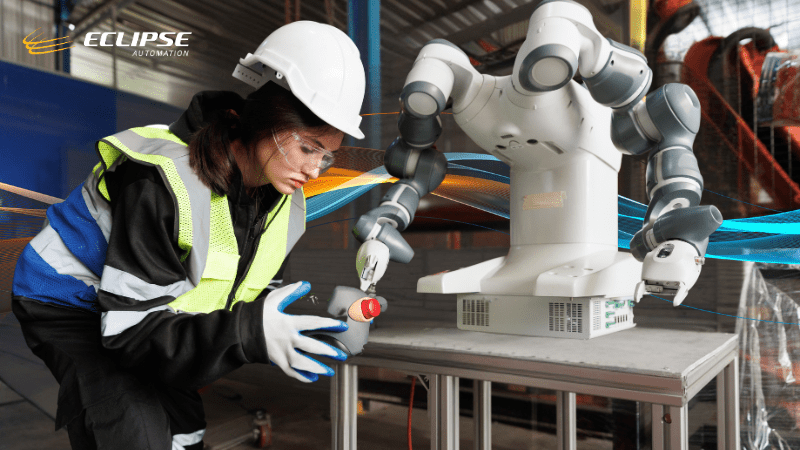


Throughout season 1 of People B4 Machines, experts across the manufacturing industry touched on a common idea: confidence in automation isn’t built overnight, but there are several ways to ease automation anxiety.
There are numerous benefits and opportunities that automation can bring to manufacturers. Despite that, automation adoption can be slowed by automation anxiety and hesitancy to embrace Industry 4.0 in the workplace.
In season 1 of People B4 Machines, industry professionals explain why automation anxiety can occur and how to overcome the fears associated with manufacturing automation.
Key takeaways
- Automation anxiety is normal, but manageable. Uncertainty is a natural part of any transformation, and organizations can reduce hesitation through preparation, communication, and education.
- Think beyond today’s problems. The most successful automation strategies don’t just solve current operational challenges. They position manufacturers for future growth, innovation, and competitiveness.
- Cybersecurity should be built in from day one. Modern automation and connectivity require a proactive cybersecurity strategy that evolves alongside emerging threats.
- Education is the foundation of adoption. Providing training, hands-on experience, and clear communication helps employees build confidence in new technologies.
What is automation anxiety?
Automation anxiety is the uncertainty, fear, or hesitation that organizations may experience when adopting new technologies such as manufacturing automation. It’s often discussed within the context of the employee’s fear regarding job security, but fear surrounding automation can stem from other concerns, as well.
Automation anxiety also affects leaders within the organization. It can include a fear of cybersecurity risks, making the ‘wrong’ investment, or other challenges arising during implementation.
Mike Nager, Solutions Center Director from Festo Didactic stresses this in episode 3. He says that while these fears affect employees at the plant floor level, it’s important to remember, “the same challenges are hitting the executive suite right now.”
“People that are CEOs, CFOs, or directors are all being challenged in a very similar manner. We have to keep in mind that it’s a company-wide phenomenon. It’s not just at the lower levels of the organizational structure,” Nager says. The good news is that uncertainty is a natural part of change, and organizations can reduce or ease automation anxiety by focusing on preparation and education.
Consider future solving, with Prasad Satyavolu and Kevin Bowers
It can be easy to assume that automation exists only to solve problems. It’s certainly a benefit, but this perspective ignores the other side of automation: Future solving.
Prasad Satyavolu, Global Lead for Industrial AI and Physical AI in Manufacturing & Operations at Accenture, explains in episode 5 that problem solving in automation is comparable to taking pain medication for present aches and pains: “You have to think ahead, to say ‘what are my vitamins that I need for my future growth?’”
Vice President of Research at the Association for Manufacturing Technology (AMT) Kevin Bowers reinforces this concept in episode 6. He says, “The old saying, ‘if it ain’t broke, don’t fix it’ [is] a terrible mentality. If that was the case, we’d still have rotary phones. We wouldn’t have smartphones, right?”
Automation is not limited by the issues of today but can create new opportunities for growth when applied proactively.
Implement cybersecurity early, with Jeff Winter
IAs automation welcomes more digital tools and offers increased connectivity, organizations find themselves at risk for more exposure to cyber threats, which introduces major fears of operational disruption and data exposure.
Jeff Winter, VP of Commercial Strategy at Belder says in episode 1 that the best way to think about cybersecurity is to avoid seeing it as an add-on but rather consider it from the beginning of the process.
“Make it continuous. Threats evolve daily. Cybersecurity in the factory of the future isn’t a project. It’s a living capability, just like maintenance or quality. So you have to treat this as one of the core fundamental aspects of how you approach your journey and your vision of Industry 4.0.”
When done right, manufacturing cybersecurity is baked into the process from the beginning. With continuous monitoring and improvement, organizations can feel confident in their automation solutions.
Preparation through education, with Jake Hall and Vanessa Loiola
In any situation, change naturally creates uncertainty. The largest barrier to automation is often cultural, not technical. Changing people’s minds on automation anxiety requires research and education that highlights the truth about industry growth: jobs are being changed, not eliminated, and jobs in automation are available.
The younger generations entering the workforce may hold misconceptions about manufacturing careers that prevent them from pursuing these opportunities, or they may simply be lacking understanding about Industry 4.0. Jake Hall, known as the “Manufacturing Millennial,” says in episode 9 that focusing on education is important for bringing in this younger workforce.
Hall says, “I think where manufacturers are falling short in terms of engagement and reach is investing in kids at a much younger age to get them involved with STEM programs or robotics or LEGA League or giving them tours to walk through the production floor in the summertime.”
Even seasoned professionals are still learning how to navigate new forms of automation as well. In episode 8, Vanessa Loiola, robotics programming specialist and founder/CEO of Valoy Automation, describes her experience with convincing clients not to fear the technology they work with, but to learn how to operate and perform simple tasks with them confidently.
Loiola explains that their hesitancy stems from the fear that they may break something. Just like with a personal vehicle, there are small things that can be done with relative ease. “You just need the right training or the right understanding,” she says.
Rapid change amplifies existing fears and anxiety, but these fears can be eased through communication and education. People fear what they don’t understand, so the solution is to make it understandable.
Building confidence in automation
Nothing can eliminate uncertainty entirely, but confidence can be built through preparation. Future-focused planning can reduce the risks associated with adopting automation, and education helps people understand and navigate the changing manufacturing landscape.
Organizations that take the time to understand the opportunities and benefits of automation while preparing for risks will be more comfortable embracing change and reduce automation anxiety.
FAQs
Frequently asked questions
Does automation eliminate jobs?
In most cases, automation changes jobs rather than eliminating them. By automating repetitive or physically demanding tasks, employees can focus on higher-value work that requires critical thinking, technical skills, and problem-solving
What’s the difference between problem solving and future solving?
Problem solving focuses on addressing today’s challenges, such as labor shortages or production inefficiencies. Future solving looks beyond immediate needs and uses automation to create new opportunities for growth, innovation, and long-term competitiveness.
Why is cybersecurity critical in Industry 4.0?
Industry 4.0 relies on connected systems, machines, and data, which can increase exposure to cyber threats if not properly secured. By building cybersecurity into automation initiatives from the start and treating it as an ongoing priority, manufacturers can reduce risk while confidently embracing digital transformation.
How does education support automation adoption?
Education helps people understand how automation works, why it’s being implemented, and how it will impact their roles. Training and hands-on experience build confidence, reduce fear of the unknown, and help create a workforce that is ready to embrace new technologies.
Explore the possibilities
Interested in building a future-ready automation strategy? Book a discovery call with Eclipse Automation to explore solutions that prioritize innovation, security, and workforce success.
Related articles and insights
-

3 tips to reduce automation anxiety for Industry 4.0 success
Reduce automation anxiety through future planning, cybersecurity, and education. Read More
-
Human-centric automation: How human-machine collaboration empowers your workforce
People-first automation unlocks productivity, resilience, and stronger employee engagement. Read More
