

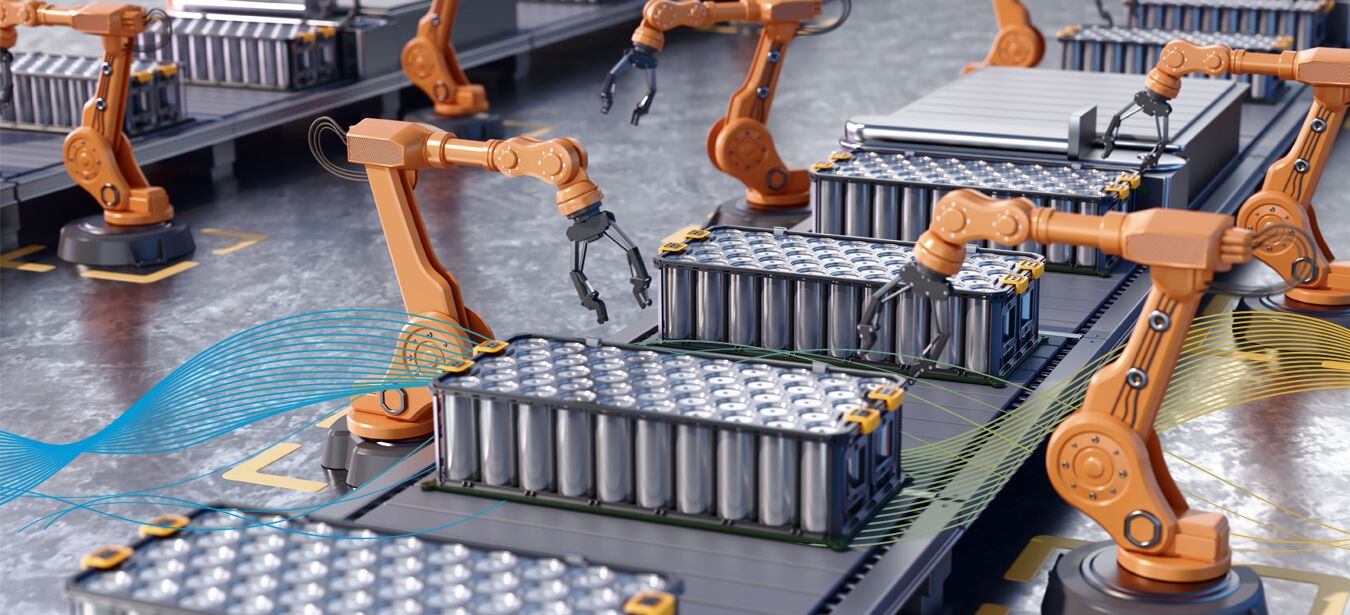


The best EV battery automation vendors for electronics manufacturers combine three strengths: proven battery line expertise across cell, module, and pack assembly, integration that connects PLC, SCADA, and MES layers into one data model, and production-ready digital capabilities such as digital twins, machine vision, and predictive maintenance. Electronics teams already know precision and volume. Battery lines raise the cost of a slow start. McKinsey reports that scrap rates during a battery line’s early ramp-up can reach 70 or 80 percent. Use integration depth, battery process experience, and digital maturity as your three filters, and ask every vendor for measured yield and OEE results from lines they have launched.
Why is battery manufacturing automation harder to scale for electronics manufacturers?
Electronics plants bring SMT-grade accuracy, clean handling, and fast changeovers. Battery production adds electrode coating, dry rooms, formation and aging, and safety-critical handling of high-voltage packs. Demand keeps climbing, too. McKinsey expects global battery demand to rise from about 1,970 GWh in 2025 to roughly 3,910 GWh by 2030, and each point of scrap is expensive. Fraunhofer FFB estimates that every percentage point of gigafactory scrap costs around €30,000 per day.
Which automation challenges show up first?
- Unstable yield at ramp-up. Small variations in coating, stacking, and laser welding compound into rejected cells and modules.
- Disconnected controls. Equipment from several OEMs arrives with separate PLC logic, so MES can’t trace a cell from coating to pack.
- Thin talent benches. Deloitte and The Manufacturing Institute project that up to 1.9 million U.S. manufacturing jobs could go unfilled by 2033, which makes self-integration risky.
Key takeaways
- Choose battery manufacturing automation vendors on three filters: integration depth, battery line expertise, and digital maturity.
- Ramp-up yield is the biggest financial risk, with early scrap rates that can reach 70 to 80 percent.
- Equipment OEMs, robotics suppliers, and software providers each solve one layer. A full-lifecycle partner owns the outcome.
- Ask vendors for measured yield and OEE results, and a plan to reach 95 percent yield within 18 months.
- Digital twins, machine vision, and predictive maintenance cut risk most when they ship with the line.
What types of industrial automation vendors serve battery production?
Most EV manufacturing automation programs draw from four vendor types. Each covers a different layer of the line, and the gaps between them are where launches slip.
| Vendor type | Integration depth | Battery line expertise | Digital capabilities |
| Process equipment OEMs | Single process step | Deep in one step, such as coating or formation | Machine-level data only |
| Robotics and component suppliers | Cell or station level | Varies by application | Vision systems and controls hardware |
| Software and platform providers | Data layer only | Limited | MES, SCADA, and Industrial IoT analytics |
| Full-lifecycle automation partners | Line to plant, OT to IT | Cell, module, and pack | Digital twins, Industrial AI, and predictive maintenance |
Robotics capacity is growing fast. The IFR reports that factories installed more than 600,000 industrial robots in 2025, up 11 percent, and credits AI and machine vision with widening viable applications. Hardware alone still needs someone to engineer, integrate, and commission it.
How should you compare EV battery automation vendors?
How deep does their integration go?
Ask whether the vendor connects operational technology across PLC, SCADA, and MES with cell-level traceability. Request a reference line where they owned engineering, build, and commissioning through rate. A single point of accountability shortens the path from first cell to stable output.
Have they launched battery lines at rate?
Look for experience across cell, module, and pack assembly, with ramp-up data to back it. McKinsey suggests leaders target yields above 95 percent and OEE of at least 85 percent within 18 months of the first cell. Ask each vendor to show how their design gets you there.
Are their digital capabilities ready for production?
Digital twins let teams validate layout, cycle time, and buffer sizing before equipment ships, and 86 percent of executives surveyed by McKinsey see factory digital twins as applicable to their operations. Scale is still rare. Deloitte found that 29 percent of manufacturers use AI and machine learning at facility or network scale, and its 2026 outlook notes that nearly a quarter plan to deploy Physical AI within two years. Ask for deployed examples of vision-guided robotics and predictive maintenance with measured results.
What sets a full-lifecycle partner apart for electronics manufacturers?
Eclipse Automation covers the full factory automation lifecycle, from advanced engineering and simulation through system design, vertical integration, installation, and post-automation support. Our batteries and EV teams work across cell, module, and pack assembly, and our electronics automation practice brings the precision those lines demand. For Viridi, we cut battery build time from hours to minutes.
Our digital manufacturing and AI portfolio extends that work. The Aurora Platform™ Series provides modular automation that shortens deployment, and Eclipse RealitySync™ lets engineering, operations, and finance leaders review the line in an immersive environment built from the same data as its digital twin. Your team sees the line, tests decisions, and aligns on capital before production starts.
FAQs
Frequently asked questions
What is battery manufacturing automation?
Battery manufacturing automation uses industrial robotics, vision systems, PLC controls, and manufacturing execution software to run electrode, cell, module, and pack processes with consistent quality and full traceability. See how Eclipse approaches batteries and EV automation.
How long does it take to ramp up a new battery line?
McKinsey notes that most gigafactories need three to six years to reach full capacity. Simulation and digital twins shorten that window by resolving bottlenecks before equipment ships. Learn more in our article on digital twin services for EV battery factories.
Can electronics manufacturers adapt existing automation for battery production?
Some assets transfer well, especially vision inspection, precision handling, and test stations. Electrochemical processes and high-voltage pack assembly usually need purpose-built cells. Our electronics automation and advanced engineering services teams can assess what to reuse.
How do digital twins reduce risk in EV manufacturing?
A digital twin models the line’s layout, cycle times, and controls logic so teams can test throughput and changeovers virtually. Issues get fixed in software, which protects commissioning schedules. Explore our digital twin experience and how to prevent commissioning delays.
What should post-launch support include for a battery line?
Look for predictive maintenance, remote diagnostics, spare parts planning, and continuous improvement tied to OEE targets. Review Eclipse post-automation services and our service and support packages.
Explore the possibilities
Ready to shorten your battery line ramp-up and protect yield from the first cell? Book a discovery call to learn how Eclipse Automation supports battery manufacturing automation for electronics manufacturers.
Related articles and insights
-

What are turnkey automation systems for regulated manufacturing?
Turnkey automation systems give regulated manufacturers one accountable partner for design, build, integration, commissioning, and ramp-up.… Read More
-
Medical automation compliance guide for 2026
FDA’s QMSR took effect in February 2026, and risk-based software assurance changed how manufacturers validate production… Read More
