

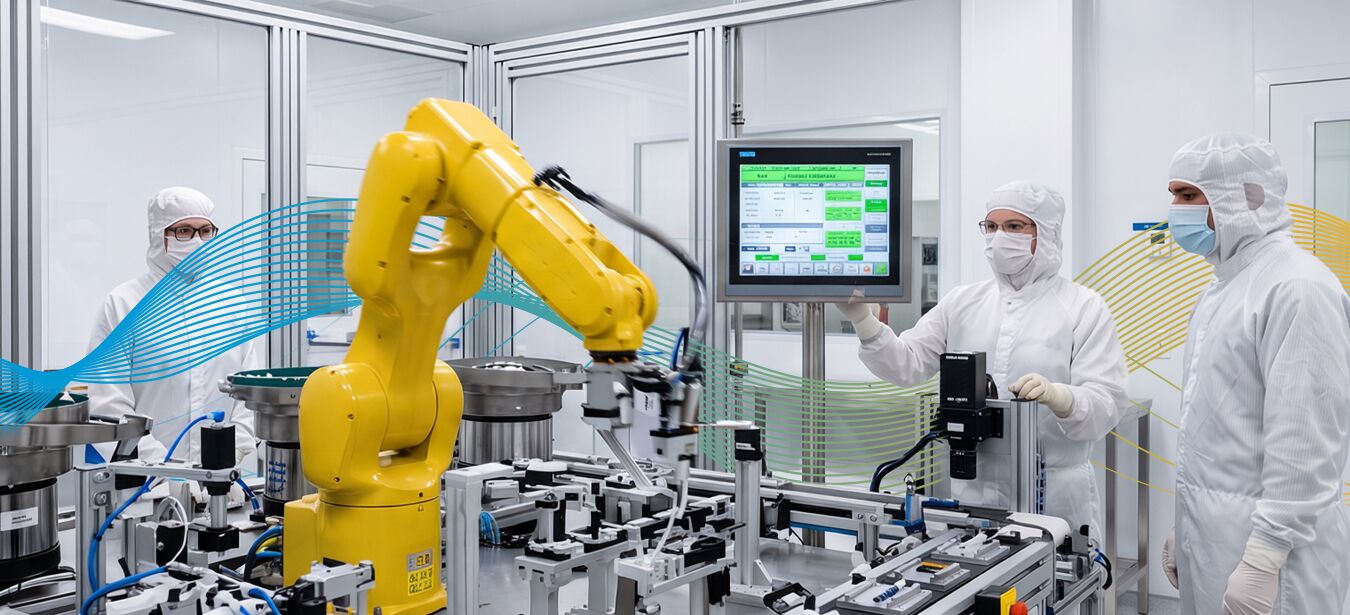


Manufacturing leaders evaluating automation retrofit partners for cleanroom medical device lines should score each integrator on five areas: validation support, regulatory alignment, cleanroom fit, systems integration depth, and lifecycle support. Then ask for proof. A credible partner can show executed FAT and SAT records, a sample traceability matrix, cleanroom design records, and production data from comparable lines. The bar moved this year. FDA’s Quality Management System Regulation took effect on February 2, 2026, bringing ISO 13485:2016 into 21 CFR Part 820. Your quality system still owns compliance. The integrator owns the evidence that its equipment meets your requirements. This scorecard builds on our life sciences integrator comparison with cleanroom-specific criteria and the evidence behind each one.
Why does cleanroom device automation need its own scorecard?
Automation demand keeps climbing. The IFR reports that annual robot installations reached 603,000 units in 2025, up 11%. Medtech is also moving production closer to customers. Deloitte found that 44% of life sciences executives are increasing regional or localized manufacturing in response to tariffs. That means more new lines, more retrofitting manufacturing lines in existing facilities, and more legacy equipment integration inside controlled environments. Cleanrooms add constraints that general factory automation scorecards miss: particle generation, material compatibility, cleanability, and limited operator access. ISO 14644-1 classifies air cleanliness by particle concentration, and your equipment has to hold that class while it runs.
Key takeaways
- Score cleanroom automation partners on validation support, regulatory alignment, cleanroom fit, integration depth, and lifecycle support.
- Request executed FAT and SAT records and a sample traceability matrix. Templates alone do not count as evidence.
- Keep regulatory obligations, which belong to you, separate from the integrator’s documented support responsibilities.
- Test scale-up readiness with specific questions on feeding, changeovers, inspection, reject handling, and production data.
- Treat missing evidence as a disqualifier and open details as follow-up questions, so the shortlist stays defensible.
What evidence should you request for each criterion?
Capability lists look alike. Evidence separates partners. Turn each criterion into a document request.
| Criterion | Evidence to request | Warning sign |
| Validation support | Redacted traceability matrix from URS to test cases, executed FAT and SAT protocols, deviation logs | Blank templates only, no executed records |
| Regulatory alignment | GAMP 5 approach, 21 CFR Part 11 design for electronic records, change control process | Claims of “FDA-approved equipment” |
| Cleanroom fit | Materials and finish list, particle mitigation design, installs at your ISO class or cleaner | No installs at your cleanroom class |
| Integration depth | PLC, SCADA, and MES integration records, vision system validation reports, Industrial IoT data architecture | Data handoff left to “customer IT” |
| Lifecycle support | Spares plan, service response times, requalification support after changes | No plan after site acceptance |
Watch the regulatory row closely. FDA regulates device manufacturers, not equipment. An integrator that claims compliant equipment is blurring the line between your obligations and its support role.
Who owns requirements, traceability, and qualification?
You own the user requirements, risk assessment, validation master plan, and final approval of IQ, OQ, and PQ. The integrator owns functional and design specifications, traceability from your requirements to its design and tests, FAT and SAT execution, and the documentation that supports your qualification. Ask every bidder to put this split in a written RACI before award.
Which cleanroom design considerations need expert review?
Have a cleanroom or validation specialist review each proposal for:
- Materials and finishes: stainless grades, polymers, and surfaces that survive your cleaning agents.
- Particle control: enclosed drives, exhausted or sealed motion, and low-shedding cable management.
- Airflow: equipment placement and profiles that avoid turbulence over open product.
- Maintenance access: service points reachable from gray space where possible.
What scale-up questions reveal real capability?
How does the line handle feeding and changeovers?
Ask how small components feed without generating particles, how long each format change takes, and which changeovers trigger revalidation. Request measured changeover times from a comparable program.
How are inspection and rejects controlled?
Ask how machine vision systems are validated, what the false-reject rate was at handover, and how the line confirms that every reject reached a secured bin.
What production data will you get?
Confirm which data reaches your MES and device history record, and whether the same data supports predictive maintenance. Deloitte reports that 29% of manufacturers use AI or machine learning at facility or network level, so plan the data architecture now. Partners that use digital twins can simulate throughput before the build.
How do you separate disqualifiers from follow-up questions?
Score each criterion from one to five and weight it by program risk. Any disqualifying gap removes a vendor, whatever its total.
| Disqualifying evidence gap | Follow-up question |
| No executed FAT or SAT records from a regulated program | Measured changeover time on your specific product formats |
| No sample traceability matrix | Vision false-reject rate on your defect library |
| No installs at your cleanroom class | Integration effort for your specific MES platform |
| No named engineering lead | Service coverage and spare parts lead times in your region |
| Refuses to define validation responsibilities in writing | Approach to mixed-technology production systems on your floor |
Ninety-two percent of manufacturers see smart manufacturing as their main competitive driver over the next three years. A scorecard built on evidence helps you pick the partner who can deliver it in a validated cleanroom.
FAQs
Frequently asked questions
What is the difference between FDA requirements and an integrator’s responsibilities?
FDA requirements apply to the device manufacturer through its quality system. The integrator supports those requirements with specifications, traceability, test records, and qualification documentation. Learn how Eclipse approaches medical device production automation.
Can existing medical device lines be retrofitted for cleanroom automation?
Yes, with a careful assessment of the equipment, controls, and cleanroom class. Legacy equipment integration usually means upgrading PLC and SCADA layers and closing data gaps to MES. Advanced Engineering Services can scope the retrofit before capital is committed.
How do digital twins support validation and scale-up?
A digital twin lets teams test layout, throughput, and changeover logic before the build, which reduces rework during FAT. Explore Eclipse’s digital twin capabilities.
What should FAT and SAT cover for a cleanroom device line?
FAT should prove functional requirements at the integrator’s facility, and SAT should confirm the same results after installation in your cleanroom. Both need executed protocols, deviations, and traceability to requirements. Vertical integration keeps that evidence under one roof.
Does automation experience from other industries transfer to medical devices?
Partly. Automotive automation services, mobility automation integration, and consumer goods automation integration build strong skills in high-volume assembly and industrial robotics. Life sciences automation integration adds validation and cleanroom discipline. See the industries Eclipse serves.
Explore the possibilities
Build a cleanroom device line that validates the first time and scales without rework? Book a discovery call to learn how Eclipse Automation supports validated cleanroom medical device automation, from concept through qualification and scale-up.
Related articles and insights
-

Cleanroom medical device automation: a partner evaluation scorecard for validation and scale-up
Evaluating integrators for cleanroom medical device automation? This scorecard links each criterion to the specific evidence… Read More
-
How to build governance for factory automation
Automation budgets are growing, but delivery often slips when ownership is unclear. This step-by-step framework shows… Read More
