

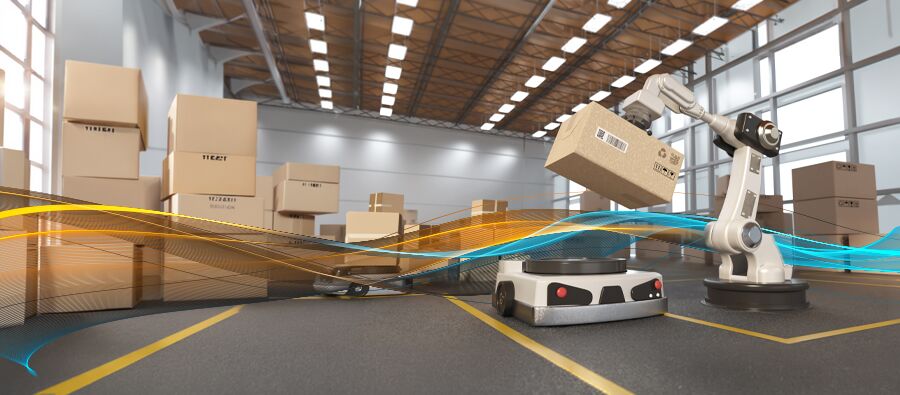


Comparing industrial robotics and AGV providers comes down to four factors: technical fit, integration depth, lifecycle support, and total cost of ownership. Large manufacturers lose the most value not from an underpowered robot arm or a slow automated guided vehicle, but from providers who cannot connect that equipment to existing PLC, MES, and SCADA systems, or who disappear once commissioning ends. The providers worth calling an enterprise automation solution support the full factory automation lifecycle, from concept engineering through predictive maintenance, rather than just the equipment sale.
Enterprise manufacturing and operations leaders, from the VP of manufacturing to the plant manager on the floor, are under pressure to scale automation faster than their labor pipeline can keep up. Deloitte and The Manufacturing Institute project that U.S. manufacturers will need as many as 3.8 million new employees by 2033, and that as many as 1.9 million of those roles could go unfilled without changes to hiring and automation strategy. That gap changes how procurement, engineering, and operations should evaluate robotics suppliers. The comparison is no longer about the lowest bid on a single cell or vehicle fleet, it is about which partner can support scalable factory automation across multiple plants, product lines, and years of operation.
Key takeaways
- Compare providers on integration depth with PLC, MES, and SCADA systems, not just equipment specifications.
- Ask how each provider supports the full factory automation lifecycle, from advanced engineering through predictive maintenance.
- Look for machine vision, digital twins, and industrial AI capability that scales across plants, not just one line.
- Weigh total cost of ownership and uptime data against the sticker price of robots or AGVs.
- Confirm the provider’s track record integrating automated guided vehicles alongside fixed robotics in the same facility.
What should you compare when evaluating industrial robotics and AGV providers?
Global demand makes this comparison harder, not easier. The International Federation of Robotics reports that 542,000 industrial robots were installed worldwide in 2024, more than double the number a decade earlier, with a global operational stock of roughly 4.66 million units. Installations are projected to grow another 6 percent in 2025 and pass 700,000 annual units by 2028. More robotics suppliers and mobile robot vendors are entering the market to meet that demand, which means large manufacturers need a consistent framework, not a feature checklist, to separate a capable integrator from a long-term automation partner.
How do you compare technical capability across robotics suppliers?
Start with the application fit. A provider should be able to explain why a fixed robotic arm, a collaborative robot, or an automated guided vehicle solves your specific material handling, assembly, or inspection problem, rather than defaulting to whichever platform they sell most often.
What role do machine vision and digital twins play?
Machine vision and vision systems determine how reliably a robot or AGV handles variation in parts, packaging, and floor conditions. Digital twins let engineering teams simulate a line before it is built, which reduces commissioning risk and shortens ramp-up. Providers building toward physical AI, where robots interpret and adapt to their environment in real time, are positioning plants for the next stage of factory automation rather than a single point solution.
How do you evaluate integration with existing PLC, MES, and SCADA systems?
Robotics and AGVs rarely operate in isolation. They need to talk to manufacturing execution systems, SCADA, and the PLC layer that already runs your plant. Ask providers how they handle industrial IoT connectivity and operational technology security, and ask for a reference plant where they integrated new equipment into a legacy control environment without a costly rebuild.
What does full lifecycle support look like from a provider?
A factory automation lifecycle includes assessment, design, build, deployment, and ongoing optimization. Providers who only sell equipment leave plant leaders to manage integration, spare parts, and troubleshooting on their own.
How important is predictive maintenance and industrial AI?
McKinsey research shows predictive maintenance can reduce unplanned downtime by up to 50 percent and lower maintenance costs by 10 to 40 percent. That level of return depends on industrial AI and sensor data being built into the robotics and AGV platform from the start, not added later as an afterthought.
How should procurement weigh cost against long-term scalability?
Procurement teams often anchor on unit price, but total cost of ownership includes integration labor, downtime risk, spare parts availability, and how easily the system scales to a second or third plant. A provider quoting the lowest price per robot or AGV can still be the more expensive choice once lifecycle support and scalability are factored in.
What questions should you ask before signing a contract?
Ask each provider to walk through a comparable deployment, show uptime and cycle time data, and explain their support model after commissioning. Ask specifically how they combine warehouse and manufacturing automation, since many plants now need AGVs and fixed robotics working in the same footprint.
FAQs
Frequently asked questions
What is the difference between industrial robotics and AGVs?
Industrial robotics typically refers to fixed or arm-based automation used for assembly, welding, or inspection, while automated guided vehicles move materials between points on the plant floor. Most large manufacturers need both working together. Eclipse Automation’s robotics experience covers how the two are designed to work as one system.
How long does it take to deploy an enterprise automation solution?
Timelines vary by scope, but providers who start with structured assessment and simulation typically de-risk the schedule before a single machine is built. Learn how that stage works in advanced engineering services.
Can AGVs and industrial robotics work together in the same facility?
Yes, and this is increasingly the standard for warehouse and manufacturing automation projects that need to move materials and process them in the same footprint. See how this applies across warehousing automation.
How do digital twins reduce automation risk?
Digital twins let engineering teams test layouts, throughput, and failure scenarios before equipment is installed, which shortens commissioning and reduces costly rework. Eclipse Automation’s digital twin experience outlines how this fits into the broader automation lifecycle.
What should be included in a provider comparison beyond price?
Integration capability, lifecycle support, predictive maintenance, and reference deployments matter as much as the quoted price. A full list of vetting questions is available in questions to ask turnkey assembly line vendors.
Explore the possibilities
Ready to compare providers with a clear, outcome-based framework?
Related articles and insights
-

How emerging industries are creating new use cases for automation
Factory automation is finding new applications as industries scale, evolve, and adopt new technologies. From data… Read More
-
How to prevent automated assembly line commissioning delays
Automated assembly line commissioning delays start long before equipment reaches the plant floor. This step-by-step guide… Read More
