

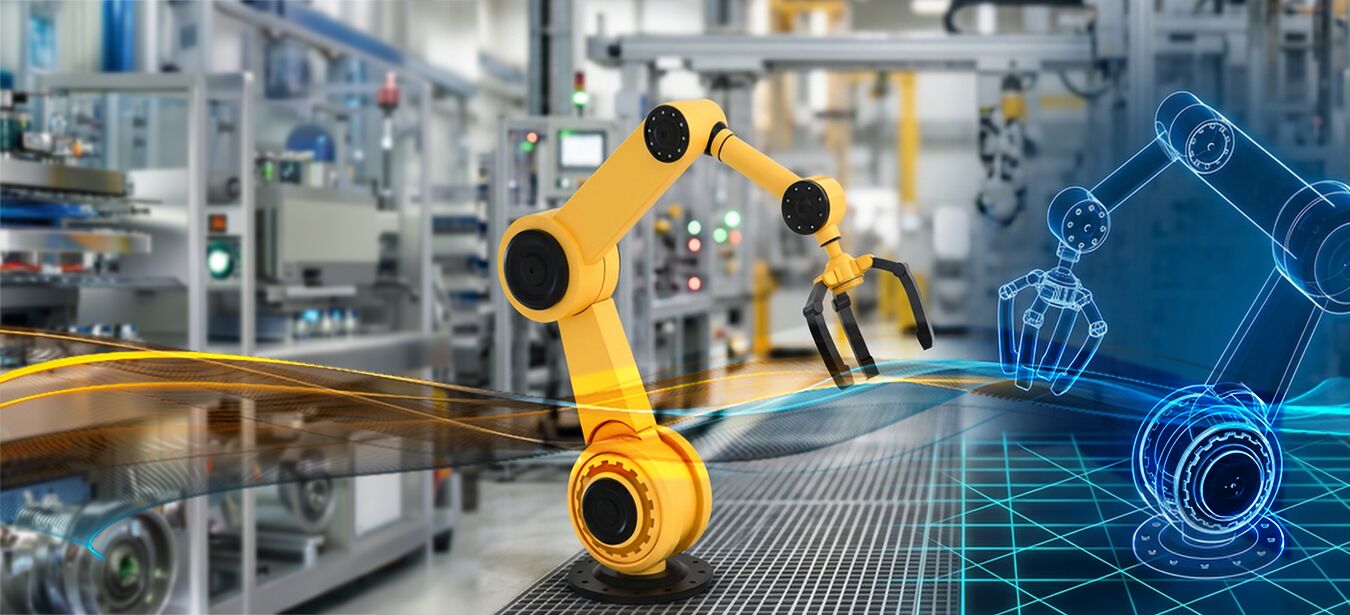


Digital twin simulation ROI is hard to prove because the value shows up in places a capital approval form never asks about. A simulation model earns its keep by catching a bottleneck before steel is cut, by validating robot reach before a cell ships, and by closing a commissioning window two weeks early. Those outcomes arrive as avoided cost, and avoided cost rarely gets a line item. The spend, meanwhile, is visible, upfront, and easy to question. Manufacturers that close this gap treat simulation as part of the automation business case and measure it against three things their leadership already funds: risk reduction, throughput gains, and faster deployment.
What makes digital twin simulation ROI so hard to measure?
Simulation pays out in events that never happen. A line that does not stall at station 40. A gripper redesign that never reaches the shop floor. A launch date that holds. Capital committees evaluate proposals against measured baselines, and a prevented failure leaves no measurement behind.
Scale compounds the problem. The World Economic Forum reports that 88% of executives struggle to capture value from these investments when they scale them across a network, while 75% of Global Lighthouse Network sites roll out new advanced use cases within six months. Method separates the two groups, not budget.
Data readiness adds friction. McKinsey found that manufacturers pursuing digital twins repeatedly run into fragmented data landscapes and a shortage of in-house talent. When PLC tags, MES records, and SCADA histories disagree, the model inherits the disagreement, and every projected number invites a debate.
Key takeaways
- Digital twin simulation value lands as avoided cost, so it needs a documented baseline before modeling begins.
- Factory simulation ROI becomes defensible when it maps to three funded categories: risk reduction, throughput, and deployment speed.
- Fragmented PLC, MES, and SCADA data undermines forecasts faster than any modeling error.
- Assign a named owner to every metric, because simulation savings spread across engineering, operations, quality, and maintenance budgets.
- Scope digital twin implementation to one line and one question first, then extend the model into Predictive Maintenance and Industrial AI use cases.
Where does the automation business case break down?
Do you have a baseline worth comparing against?
Record cycle time, changeover duration, first-pass yield, unplanned downtime hours, and engineering change orders per project before modeling starts. A forecast without a documented starting point reads as opinion. Manufacturing Execution and SCADA systems already hold most of these figures, so the real work is agreeing on definitions across sites.
Who owns the savings?
Simulation value lands across engineering, operations, quality, and maintenance budgets, which means no single leader defends it in a review. Assign an owner to each metric before the project starts, and report against that metric monthly.
How does simulation turn into risk you can price?
Risk reduction becomes currency once you price the failure modes simulation removes. Late design changes, rework on custom tooling, missed start-of-production dates, and safety incidents all carry documented costs inside your own project history. Apply published benchmarks to that history rather than to a generic model. McKinsey estimates that digital twins can improve capital efficiency and operational performance by 20 to 30 percent in capital-intensive programs, and reports that products developed as digital twins enter production with roughly 25 percent fewer quality issues. A plant that absorbed $400,000 in late-stage tooling changes last year has a real number to model against.
What do throughput and deployment speed add to the case?
Discrete event simulation answers throughput questions before capital commits. Buffer sizing, station balance, operator allocation, and Industrial Robotics cycle time all get tested virtually, and the resulting units per hour becomes a forecast operations can hold you to. Virtual commissioning extends the same model into controls, letting engineers validate PLC logic, robot motion paths, and Machine Vision inspection routines against a simulated cell while the steel is still being cut. McKinsey reports that digital twins have cut development times by 20 to 50 percent for some users, and that teams working from a live model can increase decision-making speed by up to 90 percent. Weeks removed from commissioning convert to earlier revenue, which is the clearest line on the page.
How do you build a case that survives capital review?
Start with one production line, one stated question, and three metrics. Connect the model to live Industrial IoT and Operational Technology data so the twin stays current after launch, then extend it into Predictive Maintenance and AI Manufacturing use cases once the first numbers land. Deloitte’s 2026 Manufacturing Industry Outlook found that 80% of manufacturers plan to invest 20% or more of their improvement budgets in smart manufacturing, so funding exists. Discipline is what earns it. Capgemini research puts the share of manufacturers who believe they are succeeding at scaling smart factory initiatives at 14 percent, a useful reminder that manufacturing digitalization rewards focus over breadth. Treat digital twin implementation as one stage of the Factory Automation Lifecycle rather than a standalone software purchase, and the return stays traceable across design, build, and support.
FAQs
Frequently asked questions
How long does it take to see a return on a digital twin simulation?
Most manufacturers see the first measurable return during the project that funded the model, through avoided design changes and shorter commissioning. Ongoing returns from throughput and Predictive Maintenance build over the following 12 to 24 months. Scoping the first model to a single line keeps the payback window short and the evidence clean. Eclipse Automation’s advanced engineering services team runs this assessment before capital commits.
What data does a factory digital twin actually need?
A useful model needs process times, failure and repair rates, product mix, changeover rules, and layout geometry. Live connections to PLC, SCADA, and Manufacturing Execution systems keep it accurate after launch. Our digital factory experience covers how to capture and contextualize that Industrial IoT data without a full systems overhaul.
Can simulation reduce commissioning time on the plant floor?
Yes. Virtual commissioning tests control logic, robot motion, and Vision Systems against a simulated cell, so faults surface in software rather than during runoff. Teams arrive on site with validated sequences and spend their hours on production readiness. See the digital twin experience and the Aurora Platform Series for how this shortens deployment.
How do we justify simulation for a single line rather than a whole plant?
A single line gives you a controlled comparison, a short feedback loop, and a result your finance team can audit. Model the constraint that costs you the most, prove the number, and reuse the method on the next line. Our case studies show how targeted scope produced throughput and downtime gains across different industries.
Who should be in the room when the simulation results are reviewed?
Engineering, operations, maintenance, finance, and IT each own part of the outcome, so each should see the model. Immersive review tools help non-specialists interpret results quickly. Eclipse RealitySync was built for exactly that conversation, and the factory automation lifecycle keeps those teams aligned from strategy through post-automation support.
Explore the possibilities
Curious what digital twin simulation would return on your next line? Book a discovery call to learn more.
Related articles and insights
-

How emerging industries are creating new use cases for automation
Factory automation is finding new applications as industries scale, evolve, and adopt new technologies. From data… Read More
-
How to prevent automated assembly line commissioning delays
Automated assembly line commissioning delays start long before equipment reaches the plant floor. This step-by-step guide… Read More
