

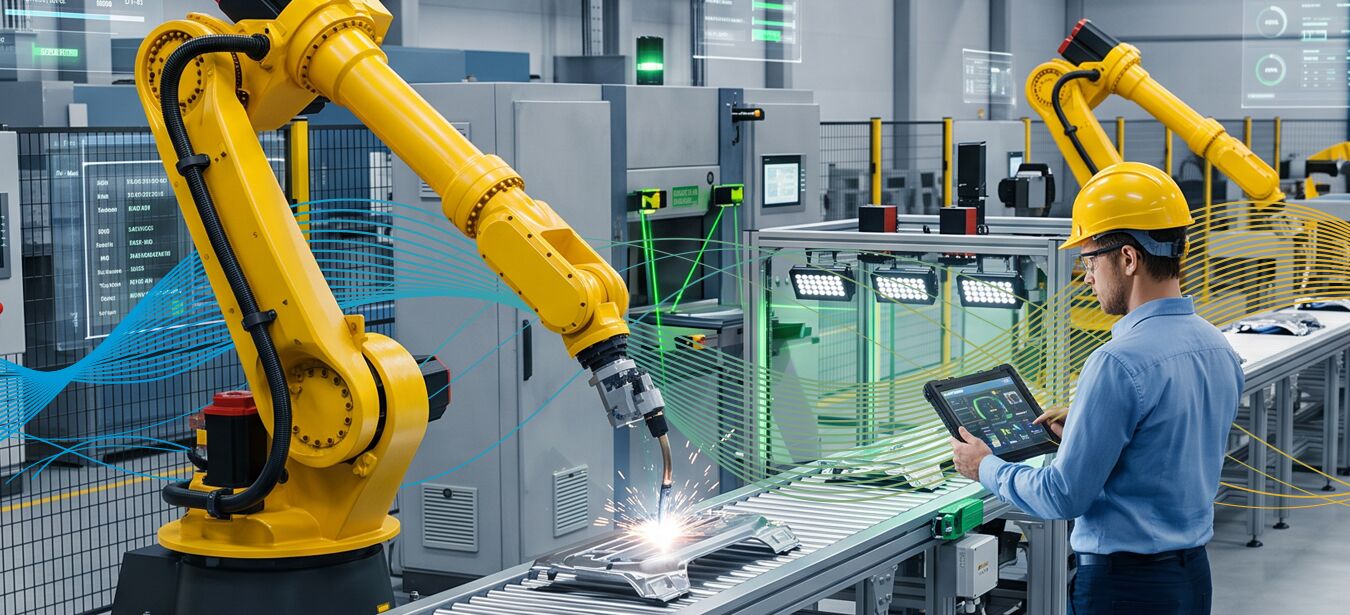


The best partner for a mixed-technology retrofit is a full-lifecycle line retrofit integrator. It connects legacy PLC, SCADA, and MES layers to new robotics and machine vision, proves the design in simulation before installation, and supports the line after launch. Manufacturing leaders evaluating automation retrofit partners in life sciences, mobility, automotive, industrial, and consumer goods share one problem: lines built over decades must keep shipping product while they change. Specialists who cover one slice of the work add handoffs, and every handoff adds risk. This guide compares partner types against the criteria that decide retrofit outcomes.
Why do line retrofits carry more risk than new installations?
Retrofitting manufacturing lines happens inside live plants. Equipment from different eras speaks different protocols, drawings have gaps, and shutdown windows are short. The upside justifies the effort. Deloitte’s 2025 survey of 600 executives found that 92% of manufacturers expect smart manufacturing to drive competitiveness over the next three years. Respondents also reported up to 20% gains in production output and 15% in unlocked capacity. Those gains depend on connecting new systems to existing operational technology, and that connection is where most projects stall.
Key takeaways
- Choose a full-lifecycle integrator for mixed-technology lines. One accountable team removes handoff risk between engineering, build, and support.
- Test legacy equipment integration early. Ask for proof of PLC, SCADA, and MES bridging on lines like yours.
- Plan for scale from day one. Standard cell designs and digital twins let you repeat a retrofit across lines and sites.
- Cut risk with simulation, factory acceptance testing, and phased cutovers inside planned shutdowns.
- Protect results after launch. Predictive maintenance typically reduces machine downtime by 30 to 50 percent, according to McKinsey.
What criteria separate the best retrofit integrators?
How well does the partner handle legacy equipment integration?
Ask for proof, not promises. A capable partner documents your installed base first, then bridges older PLC controllers to Industrial IoT gateways, SCADA, and MES without replacing equipment that still works. Request examples of retrofits that mixed controller brands and protocols on one line. Ask how the team scans and models the existing floor, because accurate as-built data prevents rework during installation.
Will the solution scale across lines and sites?
The International Federation of Robotics reports 542,000 industrial robots installed in 2024, which brought the global operating fleet to 4.66 million units. Your retrofit joins a fleet that keeps growing, so choose a partner that builds standard cell designs, reusable software libraries, and a digital twin you can copy to the next line or site. Repeatable design reduces engineering effort on every line after the first.
How does the partner reduce project risk?
Risk drops when the partner tests before touching your plant. Look for simulation, factory acceptance testing, and phased cutovers inside planned shutdowns. Scope matters too. The World Economic Forum reports that Global Lighthouse Network sites average productivity gains of around 40%, led by sites that scaled multi-technology architectures. Post-launch support protects those gains. McKinsey finds that predictive maintenance typically reduces machine downtime by 30 to 50 percent and extends machine life by 20 to 40 percent.
How do the main integrator types compare?
The table scores four common partner types against the three criteria above.
| Partner type | Legacy equipment integration | Scalability | Project risk |
| Single-technology specialist | Strong in one domain, relies on others for the rest | Limited to one skill set | High handoff risk |
| Build-to-print machine shop | Depends on your drawings and specifications | Repeatable builds, limited design input | Design risk stays with you |
| Equipment maker integrator | Strong with its own brand, weaker on mixed lines | Strong within one brand | Vendor lock-in risk |
| Full-lifecycle integrator | Strong across mixed controllers and protocols | Standard cells and digital twins | One accountable partner |
What does a retrofit look like in each industry?
Each sector stresses a retrofit in a different way.
- Life sciences: validation, traceability, and cleanroom limits shape every design choice.
- Mobility and automotive: cycle time, Machine Vision inspection, and EV battery and component assembly drive priorities in transportation and automotive automation.
- Industrial: high variant mix and long-lived equipment call for flexible tooling and controls.
- Consumer goods: high speeds and frequent changeovers favor modular cells.
How does Eclipse Automation approach line retrofits?
Eclipse Automation covers the full factory automation lifecycle: advanced engineering services, simulation, system design, manufacturing, vertical integration, installation, and post-automation support. With 750 teammates, including 400 engineers, across 12 locations, Eclipse delivers robotics, vision systems, and digital twin models through one accountable team. Customers review projects in RealitySync, an immersive collaboration app, before the line reaches the floor.
FAQs
Frequently asked questions
What is a line retrofit in factory automation?
A line retrofit upgrades an existing production line with new robotics, Machine Vision, controls, or software while keeping working equipment in place. It adds capacity and data without the cost of a full rebuild. See the factory automation lifecycle for how Eclipse structures this work.
Can legacy PLCs stay in place during a retrofit?
Often, yes. An integrator assesses each controller, then bridges it to new systems through gateways and standard protocols. Controllers that limit safety, speed, or data access get replaced in phases. Start with the factory readiness assessment.
How does a digital twin reduce retrofit risk?
A digital twin lets engineers test layouts, cycle times, and controls in simulation before installation. Problems surface on screen instead of on your floor. Learn about Eclipse’s digital twin experience.
How should I plan retrofit downtime?
Break the project into phases that match planned shutdowns. Pre-build and test cells offsite, then install and commission in short windows. Ask your integrator for a cutover plan before you sign. Our post-automation support team stays involved after launch.
Where can I find more guidance on choosing an integrator?
Browse Eclipse’s articles and case studies for retrofit examples across industries, or contact the team with your line details.
Explore the possibilities
Want to retrofit your legacy lines without halting production? Book a discovery call to learn how Eclipse Automation supports mixed-technology line retrofits across life sciences, mobility, automotive, industrial, and consumer goods.
Related articles and insights
-

Best factory automation line retrofit integrators for life sciences, mobility, automotive, industrial, and consumer goods compared
Manufacturing leaders evaluating automation retrofit partners need clear criteria. This guide compares four integrator types for… Read More
-

The virtual factory floor: An inside look at immersive technology
What if manufacturers could explore equipment and factory layouts before installation? In this episode of People… Read More
