



Can hours spent gaming prepare someone for a career in factory automation? Increasingly, yes — and gaming skills in manufacturing automation may help companies rethink where the next generation of technical talent comes from.
Manufacturers are short on skilled workers just as factories are becoming digital, sensor-linked environments built on Digital Twins, machine vision, and industrial robotics. Deloitte and The Manufacturing Institute project the U.S. sector could be short 1.9 million workers by 2033, even as automation adoption accelerates.
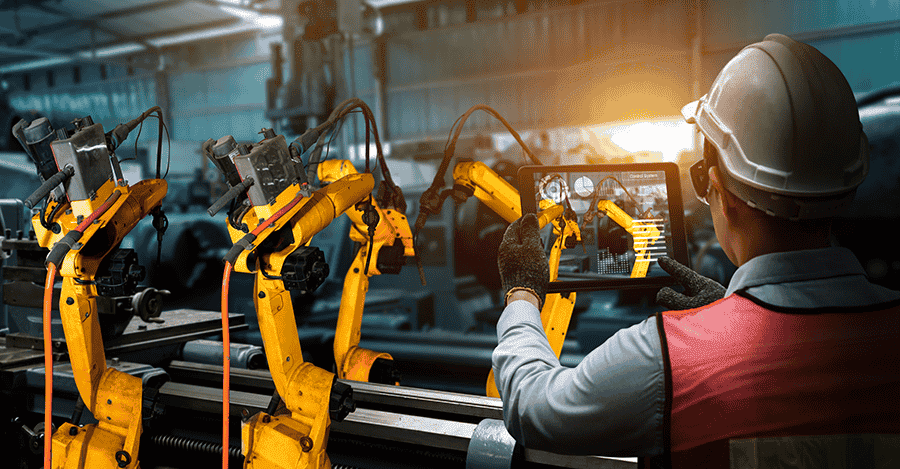
That shift is making gaming fluency surprisingly relevant. Today’s manufacturing floor increasingly resembles an interactive interface, with 3D visualization, real-time simulation, and control panels replacing static paper schematics. As Brad Zalischuk, Director of Digital Innovation and Transformation at Eclipse Automation, puts it, “I can see a future where an operations team running a manufacturing facility becomes more and more like playing an RTS (real-time strategy) game, like Starcraft or Factorio.”
Key Takeaways
- Manufacturers need technical talent as automation, robotics, and Digital Twins move faster than traditional hiring pipelines.
- Gamers often bring 3D navigation, interface adaptability, systems thinking, and experimentation skills that map directly to automation work
- The strongest candidates may combine game-engine fluency with manufacturing knowledge — a rare overlap many employers are not yet recruiting for.
Why is manufacturing struggling to fill technical roles?
The shortage is not new, but it is changing shape. Deloitte’s workforce study puts the net need for new manufacturing employees at roughly 3.8 million between 2024 and 2033, with about half of those roles at risk of going unfilled without a broader applicant pool.
At the same time, the World Economic Forum expects 39% of workers’ core skills to change by 2030, and the International Federation of Robotics reports that global industrial robot installations reached 542,000 units in 2024, more than double the number from 10 years earlier. In other words: the work is changing quickly, and the talent pipeline is not keeping pace.
What gaming skills in manufacturing automation roles are transferable?
Zalischuk, who describes himself as having been “obsessed with PCs” and “growing up on a desktop computer my whole life,” is one example of how gaming experience can translate into manufacturing innovation.
While employers often screen for traditional credentials, gamers may already understand how to move through 3D environments, learn new interfaces quickly, troubleshoot through trial and error, and think in systems. Those habits matter in smart factories, where teams are asked to interpret models, test scenarios, and understand how one change affects the rest of a line.
| Gaming skill | Automation floor application |
| 3D navigation fluency | Piloting facility models inside NVIDIA Omniverse or a plant Digital Twin |
| Systems thinking (RTS, open-world titles) | Understanding PLC logic and line-to-line dependencies |
| Resource optimization | Line balancing and Predictive Maintenance scheduling |
As Zalischuk notes, “The tough thing right now is you’ll have people that have the gaming experience and they come from the game engine world — it’s a huge pool of people — but it’s very hard to find the people who have that sort of experience and have a deep understanding of custom automation and manufacturing.”
How are digital twins and Industrial AI creating new entry points?
Factory-level Digital Twins are becoming the interface for planning and improving production. McKinsey found that 86% of manufacturing executives consider Digital Twin technology applicable to their organization, yet only 44% have implemented one and 15% are still planning a deployment.
That gap between ambition and execution is where 3D-literate, game-engine-fluent workers can add value, whether importing CAD models into a virtual factory, navigating simulations, or helping build vision systems that let a Digital Twin see what its physical counterpart is doing in real time.
The challenge is helping hiring teams recognize these skills when they do not appear on a conventional automation resume. A candidate who has built mods, worked in a game engine, managed complex simulations, or learned new software independently may already have the mindset smart factories need.
Rethinking the automation talent pipeline
Closing the automation talent gap requires manufacturers to rethink not just where they recruit, but how they define potential. Instead of looking only for traditional automation credentials, they can look for curiosity, self-directed learning, spatial reasoning, and hands-on problem-solving gained through gaming, modding, or game-engine projects.
“That overlap I think is extremely unique,” Zalischuk explains. Manufacturers that identify and develop that overlap can build a wider, more adaptable talent pipeline for Digital Twins, robotics, AI, and the next generation of smart manufacturing.
The next generation of automation talent may not come from a conventional manufacturing background. It may come from someone with a well-used gaming setup, a passion for building and problem-solving, and the drive to learn.
Article updated July 2026
FAQs
Frequently asked questions
What is a Digital Twin in manufacturing?
A Digital Twin is a continuously updated virtual model of a machine, line, or entire facility, built from real-time PLC, MES, and sensor data. Eclipse Automation’s Digital Twin experience covers how these models are used to simulate and validate production before changes reach the floor.
Do gamers need a manufacturing background to apply for automation roles?
No. Employers increasingly value 3D navigation, adaptability, and systems thinking as much as formal experience, then build manufacturing knowledge through structured onboarding.
How does Machine Vision fit into gaming-adjacent automation roles?
Vision Systems rely on the same spatial reasoning that gamers use to read a 3D environment, applied instead to guiding, inspecting, and verifying parts on a line.
What is the factory automation lifecycle?
It is the full path a project takes from early engineering and simulation through build, integration, and long-term support.
How is Eclipse Automation applying game-engine technology to real factories?
Eclipse Automation’s team has discussed how techniques like radiance field capture and game-engine rendering are changing how facilities are modeled and evaluated in its article on digital twins and machine teleportation.
Watch the vlog
Explore the possibilities
Are you a gamer who found your way into manufacturing automation, or have you worked alongside someone whose gaming background gave them an edge? We’d love to hear about it. Get in touch and tell us your story, or browse open roles if this sounds like your path.
Related articles and insights
-

How emerging industries are creating new use cases for automation
Factory automation is finding new applications as industries scale, evolve, and adopt new technologies. From data… Read More
-
How to prevent automated assembly line commissioning delays
Automated assembly line commissioning delays start long before equipment reaches the plant floor. This step-by-step guide… Read More
