

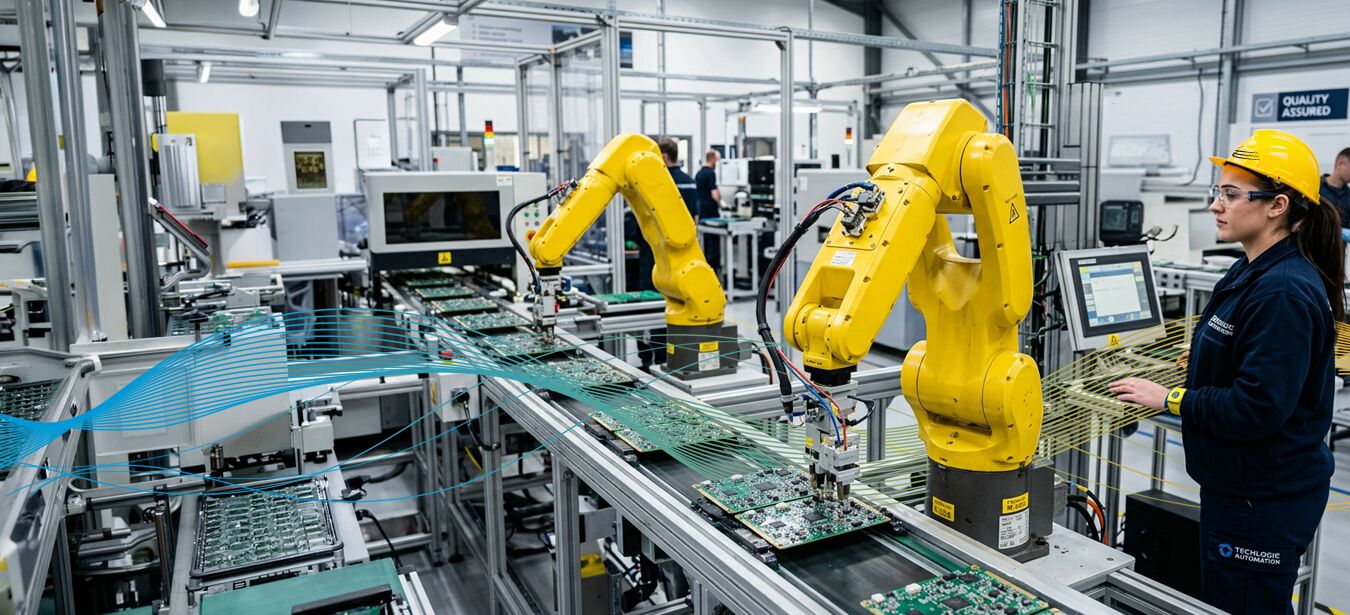


Plan an automated electronics assembly line by turning production goals into four measurable requirements before any equipment is quoted: throughput, quality, product variation, and ramp-up. Start with the demand the line must meet and the cycle time that demand implies. Set first-pass yield and traceability targets. Map every variant, changeover, and new product introduction the line will absorb over its life. Then define the ramp curve finance will hold you to. Validate all four in simulation and a digital twin, and the CAPEX request rests on numbers that engineering, operations, and finance can sign off on together.
Why does upfront planning matter so much in electronics?
Electronics now drives more industrial robotics demand than any other sector. According to the IFR’s World Robotics 2025 report, the electrical and electronics industry accounted for 24% of the 542,076 robots installed worldwide in 2024, overtaking automotive. That growth comes with pressure: shorter product lifecycles, smaller components, and wider product mixes across semiconductors, power electronics, and consumer devices. A line sized for this year’s board can be stranded by next year’s design.
Budgets are following. Deloitte’s 2025 smart manufacturing survey found that 78% of manufacturers dedicate more than 20% of their improvement budgets to smart manufacturing, with respondents reporting up to 20% gains in production output and 15% in unlocked capacity. Those returns depend on industrial automation planning that ties each investment to a defined outcome from the start.
Key takeaways
- Define throughput, quality, product variation, and ramp-up requirements before requesting equipment quotes.
- Size the line from demand and takt time, then find the true bottleneck, which in electronics is often a test, cure, or dispense step.
- Write machine vision, MES traceability, and recipe-driven PLC control into the specification so quality and changeovers scale with the product mix.
- Validate line balance, changeovers, and controls logic in simulation and a digital twin before steel is cut.
- Package validated requirements so engineering, operations, and finance approve one shared plan.
How do you turn production goals into line requirements?
Every requirement should trace back to a business goal: volume, cost per unit, quality, or launch date. Four questions cover most of the ground.
What throughput does the line need to hit?
Work backwards from annual demand, available production hours, and planned overall equipment effectiveness (OEE) to a takt time for each station. In electronics, the bottleneck is often a process step rather than a robot: functional test, reflow, adhesive cure, or semiconductor burn-in. Agree on a demand headroom target early, and specify the PLC and SCADA architecture so cycle times are measured from the first run.
What quality and traceability targets should you set?
Set targets for first-pass yield, defect escape rate, and the data each unit must carry. Machine vision and inline vision systems catch placement, solder, and connector-seating defects at the station where they occur. Connecting those stations to your manufacturing execution system (MES) ties every serial number to its process history, which gives industrial AI models clean data to learn from. McKinsey research found that products developed with digital twins can enter production with 25% fewer quality issues.
How much product variation must the line absorb?
List every current SKU, the variants on your roadmap, and a target changeover time. Then decide which stations stay dedicated and which need flexibility through industrial robotics with tool changers, recipe-driven PLC programs, and quick-change fixtures. Planning a line for three variants today and five tomorrow costs far less than retrofitting one later.
What does a realistic ramp-up look like?
Define the ramp curve in measurable terms: weeks to full rate, yield targets at each milestone, staffing levels, and training plans. Install industrial IoT sensors from day one so predictive maintenance models have baseline data before the line reaches rate.
How do you validate requirements before committing CAPEX?
Test the plan virtually before buying hardware. Discrete event simulation confirms line balance and buffer sizes. Robot simulation checks reach, cycle time, and collisions. A digital twin with virtual commissioning lets controls engineers debug PLC logic against a model, which shortens on-site commissioning. McKinsey estimates that digital technologies can reduce costs and schedules on large capital projects by up to 30%.
Leading sites already approach manufacturing plant automation this way. The World Economic Forum’s Global Lighthouse Network, now 238 manufacturing and supply chain operations, recognizes plants that pair simulation, AI manufacturing, and connected operational technology to scale results.
What should a CAPEX-ready requirements package include?
A strong package gives every stakeholder the same view of the line:
- A throughput model with takt time, OEE assumptions, and bottleneck analysis
- A quality plan covering inspection points, yield targets, and traceability data
- A variant matrix with changeover targets and flexible stations identified
- A ramp curve with milestones, staffing, and training
- An OT and IT integration map for PLC, SCADA, and MES
- Simulation results that confirm the line performs as specified
Treat this package as the first stage of the factory automation lifecycle. The same requirements carry through design, build, factory acceptance testing, installation, and post-launch support, so the team that approves the CAPEX can measure the line against the targets that justified it.
FAQs
Frequently asked questions
What are advanced engineering services in factory automation?
Advanced engineering services are pre-automation studies that assess, plan, and validate an automation opportunity before significant capital is committed. They typically include process discovery, bottleneck analysis, ROI evaluation, and robot, cell, and line simulation. Learn more about Eclipse Automation’s advanced engineering services.
When should a digital twin be built for a new electronics line?
Build it during concept and requirements planning, before equipment is quoted. An early twin lets you test line balance, changeovers, and controls logic while changes are still inexpensive, and the same model carries forward into commissioning and operations. See how digital twin simulation supports ROI.
Can one automated line handle multiple electronics products?
Yes, when variation is planned into the requirements. Recipe-driven PLC programs, robotic tool changers, quick-change fixtures, and vision systems configured for each variant let a single line run several products with short changeovers. Explore Eclipse Automation’s electronics automation capabilities.
Which systems should an automated electronics assembly line connect to?
At minimum, connect PLCs and SCADA on the plant floor to your MES for traceability and production tracking, and to ERP for orders and materials. Planning these operational technology and IT connections early prevents rework during integration. Read about the full factory automation lifecycle.
How does requirements planning reduce ramp-up risk?
Clear ramp targets, validated in simulation, expose bottlenecks and integration gaps before the line ships. Teams arrive at installation with tested logic, trained operators, and baseline data, so the line reaches rate sooner. Book a discovery call to talk through your ramp-up plan.
Explore the possibilities
Want to validate throughput, quality, and ramp-up before committing CAPEX? Book a discovery call to learn how Eclipse Automation supports automated electronics assembly planning, simulation, and ramp-up.
Related articles and insights
-

Hiring for the factory of the future: What manufacturers should look for
As automation changes manufacturing jobs, employers need to rethink the skills they look for. In this… Read More
-

How to scale battery module and pack assembly without creating new bottlenecks
Scaling battery module and pack assembly starts with the whole line. Learn how manufacturing engineering and… Read More
