

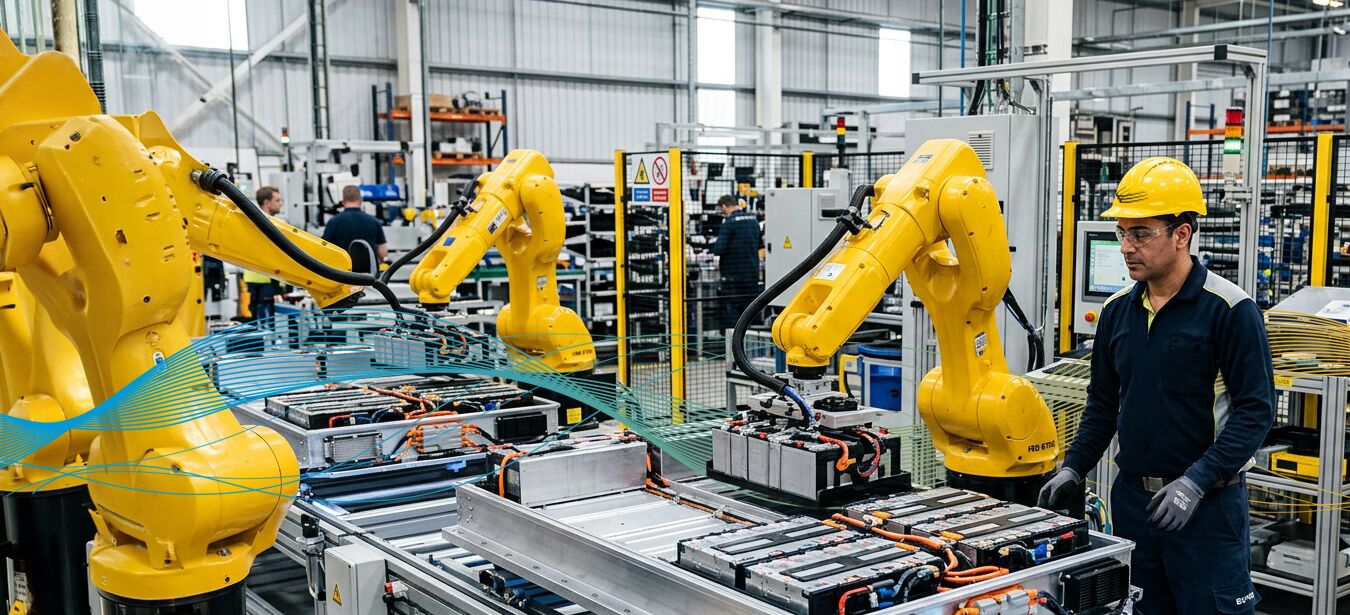


To scale battery module pack assembly without creating new bottlenecks, assess the whole line before you add capacity. Map process dependencies, confirm every station can hold the new takt time, model material flow at the target rate, and make sure traceability keeps pace with each added unit. Validating these four areas in a digital twin before committing capital lets engineering and operations teams raise output while protecting yield, cycle time, and compliance. Skip that step, and the constraint usually moves one station downstream instead of disappearing.
Why does scaling battery module and pack assembly shift the bottleneck?
Demand keeps pushing volume targets higher. The International Energy Agency’s Global EV Outlook 2026 projects 23 million electric car sales this year, close to 30% of new car sales worldwide. Capgemini expects global battery production to reach 3.5 TWh by 2030, six times the 2022 level.
Module and pack lines are tightly coupled. Cell sorting, stacking, laser welding, busbar joining, adhesive dispensing, curing, leak testing, and end-of-line electrical test all feed each other.
Speed up one station and the next one becomes the constraint. During ramp-up, that imbalance shows up as scrap. Research from Fraunhofer FFB finds scrap rates of 15% to 30% are common in the first years of battery cell production, and its ramp-up white paper puts the cost of each percentage point at a large plant near €30,000 a day.
Key takeaways
- Map process dependencies first. Curing, testing, and weld inspection usually set the real pace of a battery module pack assembly line.
- Size every station to the target takt time, including availability, changeovers, and rework loops, before adding equipment.
- Model material flow at full volume so heavier packs, buffers, and kitting never starve or block the line.
- Build traceability into the architecture now. The EU battery passport becomes mandatory on February 18, 2027.
- Validate scale-up in a digital twin to cut commissioning risk and protect yield during ramp-up.
What should you assess before increasing output?
Four areas decide whether added capacity turns into added output.
Which process dependencies set the real pace?
Adhesive cure times, leak tests, and end-of-line tests are fixed-duration steps that rarely shrink when you add robots upstream. Pull actual cycle data from the PLC and MES layer, then identify which steps run in series and which can run in parallel. A move toward cell-to-pack designs can remove the module stage entirely, so confirm the product roadmap before you freeze the line layout.
Does each station match the target takt time?
Compare each station’s effective cycle time with takt at the new volume. Include availability, changeovers, operator response, and rework loops in the math. A welder running at 95% availability can still constrain the line if its rework path feeds back into the same station. Predictive maintenance on laser sources, dispensers, and screwdriving spindles protects the capacity you plan for.
Can material flow keep up at higher volume?
Packs get heavier and harder to move at every station. Industrial robotics, autonomous mobile robots, and right-sized buffers keep stations fed without flooding the floor with work in progress. Model cell supply, kitting, and finished-pack outflow at the target rate.
Will traceability scale with every added unit?
Traceability now controls market access. Under EU Regulation 2023/1542, every EV battery placed on the EU market needs a battery passport from February 18, 2027. Machine vision inspection results, weld parameters, torque values, and test data must link to each serial number through MES and SCADA without slowing the line. Capgemini estimates a 10-point scrap reduction can save $200 million to $300 million a year at a 30 GWh plant, and clean traceability data is how teams find those points.
How do digital twins and industrial AI reduce scale-up risk?
A digital twin lets teams test volume scenarios before touching the floor. Engineers can run line-level simulation, stress-test buffers, and validate PLC logic through virtual commissioning. Industrial AI then turns live Industrial IoT data into earlier warnings on drift, defects, and equipment health, while Physical AI helps robots and vision systems adapt to part variation in real time. Deloitte’s 2025 Smart Manufacturing Survey reports average gains of 10% to 20% in production output and 10% to 15% in unlocked capacity. Adoption keeps climbing, with the International Federation of Robotics counting a record 5 million industrial robots operating in factories worldwide in 2025.
Eclipse Automation applies this approach across the factory automation lifecycle. Through Advanced Engineering Services, teams run bottleneck analysis, volume ramp-up planning, and digital twin feasibility studies before capital is committed, so every machine arrives simulation-ready.
What does a practical scale-up sequence look like?
Baseline current performance with real OEE, scrap, and cycle data. Model the target volume in a digital twin and find where the constraint moves. Validate fixes virtually, then phase physical changes so each step proves out before the next. Finally, connect operational technology and MES data so the line keeps improving after ramp-up.
FAQs
Frequently asked questions
What usually limits throughput in battery module and pack assembly?
Fixed-duration steps such as adhesive curing, leak testing, and end-of-line electrical testing often set the pace. Weld inspection can also become a constraint at higher rates. Learn how Eclipse engineers machine vision systems that keep inspection at production speed.
How does a digital twin help scale battery pack assembly?
It lets teams simulate higher volumes, size buffers, and commission control logic virtually before changing the floor. That shortens ramp-up and lowers capital risk. See how to measure digital twin simulation ROI, or watch the digital twin technology video.
What traceability data will EV battery packs need?
Each in-scope battery sold in the EU needs a digital passport from February 2027. On the line, that means serial-level records of inspection, weld, torque, and test results tied to material data. Explore Eclipse’s EV and battery automation capabilities.
Should we expand an existing line or build a new one?
It depends on your product roadmap, floor space, and where the constraint sits. Many teams add parallel capacity at the constraint first, then plan new lines once the design stabilizes. Advanced engineering services help compare both paths before you commit capital.
When should we bring in an automation partner?
Early. Engaging a partner during concept and simulation, before equipment specifications are fixed, gives the most room to balance capacity, flow, and traceability. Learn more about the full factory automation lifecycle.
Explore the possibilities
Planning to scale battery module and pack assembly without creating new bottlenecks? Book a discovery call to learn how Eclipse Automation supports battery module and pack assembly scale-up.
Related articles and insights
-

Hiring for the factory of the future: What manufacturers should look for
As automation changes manufacturing jobs, employers need to rethink the skills they look for. In this… Read More
-

How to scale battery module and pack assembly without creating new bottlenecks
Scaling battery module and pack assembly starts with the whole line. Learn how manufacturing engineering and… Read More
