

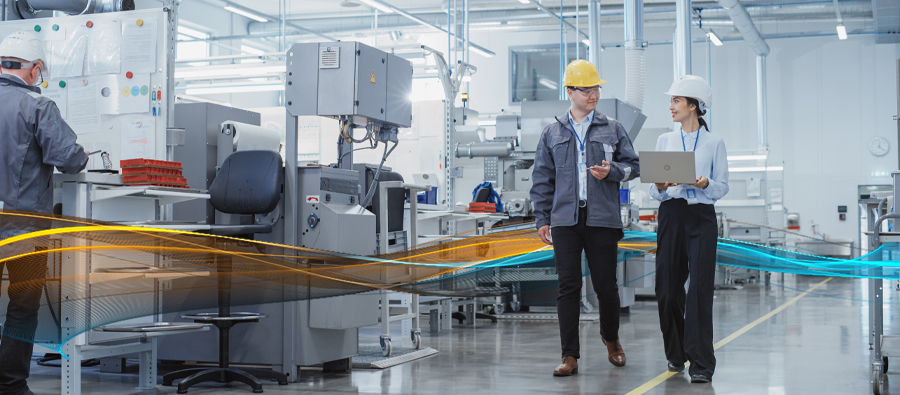



Choosing a factory automation partner comes down to nine questions that test four things: technical fit, delivery model, automotive production scale, and lifecycle support. Ask who owns process risk, how a design gets validated before build, where the equipment is manufactured, whether the partner has held automotive takt times, how the system connects to your PLC, MES, and SCADA layers, and what support looks like in year five. Strong candidates answer with numbers from launched lines. Weaker ones answer with capability slides. The nine questions below give engineering and operations leaders a consistent way to score every vendor on the same terms.
Why does the choice of partner decide the result?
Capital keeps moving into the plant. A 2025 Deloitte survey of 600 manufacturing executives found that 80% plan to invest 20% or more of their improvement budgets in smart manufacturing, with automation hardware, sensors, and analytics at the top of the list. Returns are far less consistent. The McKinsey COO100 survey of manufacturers with at least $1 billion in revenue found roughly two-thirds still at the exploration or targeted implementation stage, and only 2% with technology fully embedded across operations. Nearly half, 46%, cite limits in their data or IT/OT systems. Those limits get designed in during vendor selection, long before anyone discovers them on the floor.
Key takeaways
- Nine questions cover the four areas that decide outcomes: technical fit, delivery model, automotive production scale, and lifecycle support.
- Deloitte reports 80% of manufacturers plan to commit 20% or more of improvement budgets to smart manufacturing, so selection discipline now matters more than budget size.
- Process proof, machine vision detail, and early PLC, MES, and SCADA planning separate a systems partner from an equipment supplier.
- Vertical integration and digital twin validation shorten lead times, cut change orders, and make line replication repeatable across a global manufacturing footprint.
- Lifecycle support, including predictive maintenance and spare parts strategy, drives total cost of ownership long after buy-off.
How do you confirm technical fit?
1) Can they prove the process before quoting the machine?
Ask for feasibility data on your part, not a similar one. A capable partner runs process trials, publishes cycle time and yield assumptions, and shows exactly where tolerance risk sits. Advanced engineering work done up front lowers the odds of a redesign after buy-off.
2) How do they design vision and inspection?
Machine vision decides whether quality claims survive at volume. Ask which defects the system detects, at what confidence level, and what happens to borderline parts. Lighting, fixturing, and part presentation shape vision system results far more than camera specifications do.
3) Do they design for PLC, MES, and SCADA from day one?
Controls architecture sets the ceiling on your factory data. Confirm the partner will map tag structures to your manufacturing execution and SCADA standards, keep operational technology properly segmented from IT, and hand over documentation your team can maintain. Industrial IoT and digital factory plans depend on that groundwork.
What does the delivery model tell you?
4) Who engineers the system, and who builds it?
Handoffs create schedule risk. Ask what share of machining, controls, and assembly happens in house rather than through subcontractors. Vertical integration affects lead time, change order volume, and who answers the phone when a milestone slips.
5) Do they validate with digital twins before steel gets cut?
Simulation catches reach, layout, and throughput problems while a change still costs hours instead of weeks. Ask to see a digital twin from a completed project, the specific design decisions it changed, and how the model is maintained once the line runs.
6) Can they support global manufacturing across regions?
If the plan is to replicate a line in three plants, ask about local engineering coverage, spare parts stocking, and build-to-print duplication. Consistent documentation keeps the second and third installations from turning into custom projects.
Can they handle automotive production scale?
7) Have they held automotive takt times?
Automotive production remains the toughest proving ground. The International Federation of Robotics reports that around 40% of new industrial robot installations in the United States in 2024 went to the car industry. Ask for cycle time, OEE, and first-pass yield from a launched automotive line, with the ramp curve attached.
8) How do they select industrial robotics and industrial mobility?
Fixed cells and mobile fleets solve different problems. ABI Research sizes the mobile robot market at $33 billion in 2026, rising to $68.9 billion by 2030. Ask how the partner evaluates AGV providers alongside industrial robotics vendors, whether fleet management ties into your MES, and who owns traffic and safety logic.
What happens after the line is running?
9) What does lifecycle support cover in year five?
Ask for response time commitments, spare parts strategy, remote diagnostics, and how predictive maintenance data reaches your maintenance team. Around three-quarters of surveyed COOs expect a hybrid build, buy, and partner model, so post-automation support terms deserve the same scrutiny as the build quote.
How should you score the answers?
Run all nine questions against every vendor and require evidence: a reference line, a data set, a named engineer. Answers that arrive as numbers tend to predict projects that arrive on schedule. Answers that stay general tend to predict longer commissioning and a heavier workload for your own team. Reviewing customer results from comparable programs is the fastest way to test both.
FAQs
Frequently asked questions
What separates a factory automation partner from an equipment supplier?
A supplier delivers a machine against a specification. A partner owns the process outcome across the full automation lifecycle, from feasibility and simulation through build, commissioning, and long-term support.
How early should a digital twin enter the project?
During concept, before layout is frozen. A digital twin validates throughput, reach, and buffer sizing while changes are still inexpensive, and it becomes a training and troubleshooting asset once production starts.
Should we choose industrial robotics or AGVs for material movement?
It depends on route stability, payload, and how often layouts change. This comparison of industrial robotics and AGV providers walks through the trade-offs, and a companion guide covers how to evaluate providers on total cost and integration.
How do we evaluate lifecycle support before signing?
Request named response times, escalation paths, spare parts lead times, and a sample health report. Eclipse Automation publishes its service and support model so teams can compare terms directly.
What should automotive manufacturers ask that others might skip?
Ask about takt time held under ramp conditions, changeover time between variants, and traceability depth per part. Automotive automation programs live or die on those three numbers.
Explore the possibilities
Ready to score your shortlist against these nine questions?
Related articles and insights
-
Physical AI in manufacturing: Seeing beyond the demonstration
Physical AI is expanding what robots may be able to do, but manufacturers still need to… Read More
-

How to structure a medical automation RFP
A medical automation RFP defines workflow, compliance, integration, and service requirements before providers see it. This… Read More
