
Mike MacDonald, VP Operations Canada
At a BMW assembly line in Spartanburg, South Carolina, a worker positions a sheet of adhesive-backed insulation against a car door’s inner panel. Right beside them—no safety cage, no barriers—a collaborative robot extends its arm and begins rolling the material into place with precise, consistent pressure. The worker moves to the next door, and the robot follows. It’s a synchronized dance that repeats hundreds of times per shift, with neither partner missing a beat.
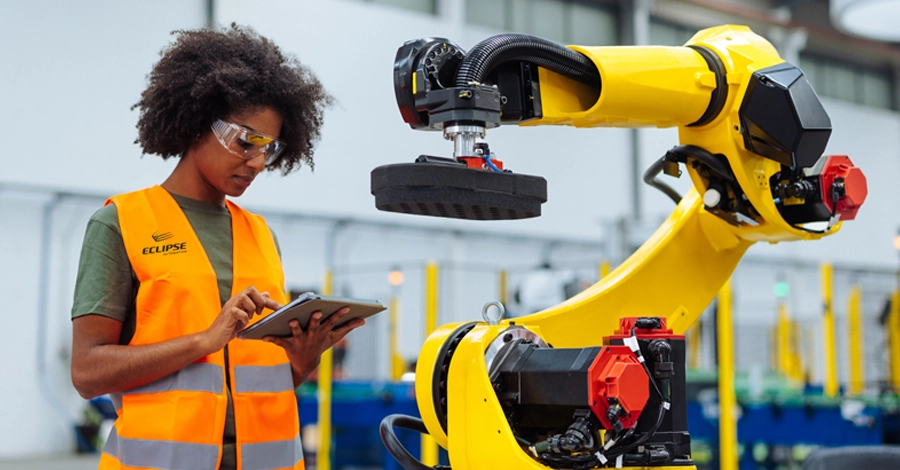
Once unthinkable in traditional automotive manufacturing, scenes like this are now reality throughout the industry. Unlike their industrial predecessors locked behind safety fences, collaborative robots (or “cobots”) work alongside humans, handling repetitive and ergonomically challenging tasks while workers focus on quality control and complex assembly steps.
The numbers tell a compelling story: cobots accounted for approximately 10.5% of all industrial robots installed in 2023, or about 57,000 units worldwide. While Asia leads with 70% of new robot installations, the global automotive industry has emerged as a primary adopter, particularly for final assembly and finishing tasks where flexibility matters most.
In this article
- Cobots represent an important shift in manufacturing automation, designed to work safely alongside humans without traditional safety barriers, guided by ISO 10218 and ISO/TS 15066 standards.
- Automotive manufacturers are benefitting: faster changeovers, improved ergonomics, and consistent quality in tasks like adhesive application, sanding, and assembly.
- The technology excels in high-mix/low-volume production, with typical payback periods under 12 months for well-chosen applications.
- Success requires careful task selection, focusing on ergonomically challenging, repetitive work that benefits from consistent force application.
- Future trends point toward greater AI integration and expanded applications as the technology matures and costs continue to decline.
What makes a robot “collaborative”?
Traditional industrial robots are powerful, fast… and potentially dangerous, operating behind safety fences at speeds that could injure anyone who gets too close. Cobots flip this paradigm: using force sensors, vision systems, and sophisticated safety protocols, they’re designed from the ground up to share work space with humans.
The technical standards regulating this shift—ISO 10218 (updated in 2025) and ISO/TS 15066—define four collaborative operation modes:
- Safety-rated monitored stops when humans enter the workspace
- Hand-guiding for teaching new tasks
- Speed-and-separation monitoring that maintains safe distances
- Power-and-force limiting that ensures any contact remains below biomechanical injury thresholds
It’s this last mode that enables the truly collaborative applications transforming automotive assembly lines.
The journey to mainstream adoption has been methodical. Early collaborative robots emerged in the mid-1990s from research labs, but it wasn’t until the 2010s that they became commercially viable. The automotive industry, despite its long history with automation dating back over a century, initially approached cobots cautiously. As recently as 2019, only 10% of automakers had deployed AI-enabled automation at scale. By 2022, that figure had jumped to 80%, with cobots playing a significant role in this transformation.
Why automotive manufacturing needs cobots now
Modern automotive factories face growing challenges. Product cycles are shortening, model variants are multiplying, and the transition to electric vehicles demands entirely new assembly processes. Meanwhile, manufacturers worldwide report skilled labor shortages, with 85% citing difficulty finding qualified workers for their automated systems.
Enter cobots. Unlike traditional automation that requires extensive re-engineering for each product change, cobots can be reprogrammed in hours or even minutes. They excel at tasks that are difficult to fully automate but benefit from robotic precision, like applying consistent force when rolling adhesive strips, maintaining exact torque during assembly, or performing quality inspections that require both vision systems and human judgment.
The numbers validate the approach. BMW reports saving more than 500 minutes of unplanned stoppages annually through predictive maintenance enabled by cobot sensors. Ford’s Craiova plant in Romania uses UR10 cobots for greasing camshafts and filling engines with oil, tasks that require precision but also benefit from human oversight. These aren’t isolated successes—similar results are emerging from Hyundai, Daimler, and other major manufacturers.
The cobot advantage: Flexibility meets precision
What makes cobots particularly valuable in automotive manufacturing isn’t just their ability to work alongside humans, but their unique ability to solve multiple problems simultaneously.
Rapid deployment and redeployment stand out as primary advantages. While traditional robot cells can take weeks to program and install, cobots can be operational in days. When production needs change, they can be moved to entirely different tasks without major infrastructure modifications.
They’re space efficient as well. Eliminating safety fencing means cobots can fit into existing production lines without major layout changes—a crucial advantage in brownfield facilities where space is at a premium.
Ergonomic improvements also address a critical human factor. At BMW’s Spartanburg plant, those four cobots rolling insulation don’t just ensure consistent quality, they eliminate a repetitive motion task that previously caused worker fatigue and potential injury. The robots handle the force-critical rolling while workers focus on positioning and quality checks.
Cost-effectiveness seals the cobot deal for many manufacturers. Industry sources commonly report payback periods under 12 months for appropriate applications.
Real-world transformations: Cobots in action
The true measure of any technology is its real-world impact, and in automotive manufacturing, cobots are proving their worth across diverse applications.
At Ford’s Cologne plant, cobots perform precision sanding on Fiesta bodies before painting, a task requiring consistent pressure and coverage that was previously both labour-intensive and ergonomically challenging. The robots work in choreographed sequences, with engineers supervising and adjusting parameters in real-time. Ford found the results so compelling they’ve explored extending the application to facilities in Valencia and Craiova.
BMW’s door insulation application at Spartanburg represents another breakthrough. The task requires precise control: too little pressure and the adhesive won’t bond properly, too much and the material can tear or wrinkle. Cobots deliver exactly the right force every time, while workers ensure proper alignment and handle any irregularities.
This is just a small sampling of the automotive tasks where cobots excel. They’ve also proven adept at dispensing adhesives and sealants with precision, tightening bolts to exact torque specifications, performing vision-guided quality inspections, handling delicate electronic components in EV battery assembly, and supporting machine tending operations in powertrain manufacturing.
Navigating the challenges
Despite the benefits, cobot adoption isn’t without obstacles. Safety compliance, while simplified compared to traditional robots, still requires rigorous attention. Risk assessments must evaluate each collaborative application against ISO/TS 15066 biomechanical limits. Force and pressure thresholds vary by body region—what’s acceptable for contact with a worker’s arm may be dangerous for their head or neck.
Cobots can’t be simply dropped into existing processes. Workflows must often be rethought to optimize human-robot collaboration, and workers retrained on safety protocols and new ways of working that leverage each partner’s strengths.
Workers themselves may fear job displacement or struggle to trust robotic colleagues. Successful implementations invest heavily in training and communication, emphasizing how cobots enhance rather than replace human capabilities.
There are also persistent performance limitations: optimized for flexibility and safety rather than speed, cobots typically operate slower than traditional industrial robots. Applications requiring high-speed operation or heavy payload handling still demand traditional automation solutions.
Trends shaping cobot evolution—for automotive and beyond
While the automotive industry has been ahead of the curve for cobot adoption, the market is evolving rapidly, with several trends pointing toward expanded capabilities and applications.
AI integration is accelerating cobot adaptability. Machine learning algorithms enable robots to optimize their movements based on production data, predict maintenance needs before failures occur, and even learn new tasks through demonstration rather than programming.
Cloud connectivity promises to unlock new levels of coordination. Cobots connected to MES can automatically adjust to production schedule changes, share learned optimizations across multiple units, and provide real-time performance data for continuous improvement.
Advanced sensing continues to improve. Next-generation vision systems, tactile sensors, and even proximity detection that can sense human intention are making human-robot collaboration more intuitive and productive.
While assembly and material handling dominate today, cobots are beginning to tackle more complex tasks like collaborative welding, precision grinding, and even some painting applications—all while maintaining safe human interaction. This makes them relevant far beyond automotive manufacturing.
Making cobots work for your operation
For manufacturers considering collaborative robots, success starts with choosing the right task. Look for applications that combine some of the following:
- Repetitive motions that cause worker fatigue
- Operations requiring consistent force or torque application
- High-mix/low-volume production with frequent changeovers
- Quality-critical tasks benefiting from both automation and human oversight
- Space-constrained areas where traditional robot cells won’t fit
Rather than attempting to transform entire production lines, successful adopters typically begin with one or two well-chosen applications, prove the value, then expand. This builds internal expertise, demonstrates ROI, and helps overcome cultural resistance.
The rise of collaborative robots represents a fundamental shift in how we think about human-machine interaction in manufacturing. For the automotive industry, with its complex assembly requirements, multiple model variants, and ongoing workforce challenges, cobots offer a path to increased flexibility, improved quality, and better working conditions. And with typical payback periods under a year and the flexibility to adapt as production needs change, the economic case is equally compelling.
As we’ve shown, cobots will undoubtedly transform automotive manufacturing—the question is how quickly manufacturers will adapt to this new paradigm. Those who successfully integrate collaborative robots into their operations won’t just improve their current processes; they’ll build the flexibility and capabilities needed to thrive in an increasingly dynamic manufacturing landscape.
Ready to explore how collaborative robots can transform your operations? Eclipse Automation’s expertise in custom automation solutions and collaborative robot integration can help you identify and implement a solution that fits your needs.