

Tracey Thomas, Content Communications Specialist
The disconnect between executive leadership and factory operations has existed for decades, creating barriers to successful automation implementation.
We recently interviewed Jeff Burnstein, President of the Association for Advancing Automation (A3), for an episode of People B4 Machines, a podcast that explores the chaos of factory automation, from Monday morning to the very near future.
In this article
- Why communication gaps between leadership and operations derail automation
- How fear, unrealistic expectations, and misaligned goals create friction
- The “start smart” approach to build confidence and momentum
- Leadership’s role in setting expectations, defining metrics, and valuing people
- A full recording of the podcast episode featuring Jeff Burnstein
Listen to the full conversation
Hear Jeff Burnstein’s full episode, Top floor to shop floor: Why is it taking so long to connect these floors?, and explore more conversations on the human side of factory automation at peopleb4machines.com.
Why communication gaps hold factories back
According to Burnstein, the disconnect is driven by uncertainty around how robotics and automation will affect operations, jobs, and competitiveness.
“There’s still so much mystery about robotics and automation – how you should go about implementing it, what impact it will have, and how you’re going to communicate it. Those things have to be handled properly or you’re not going to be successful,” he explained.
The root of the problem lies in communication breakdowns and unrealistic expectations. Many companies struggle with fear among workers about job displacement, while executives often view automation as a silver bullet that will solve all operational problems.
This creates friction when implementations don’t deliver immediate results, leading to blame rather than collaborative problem-solving.

The start smart approach
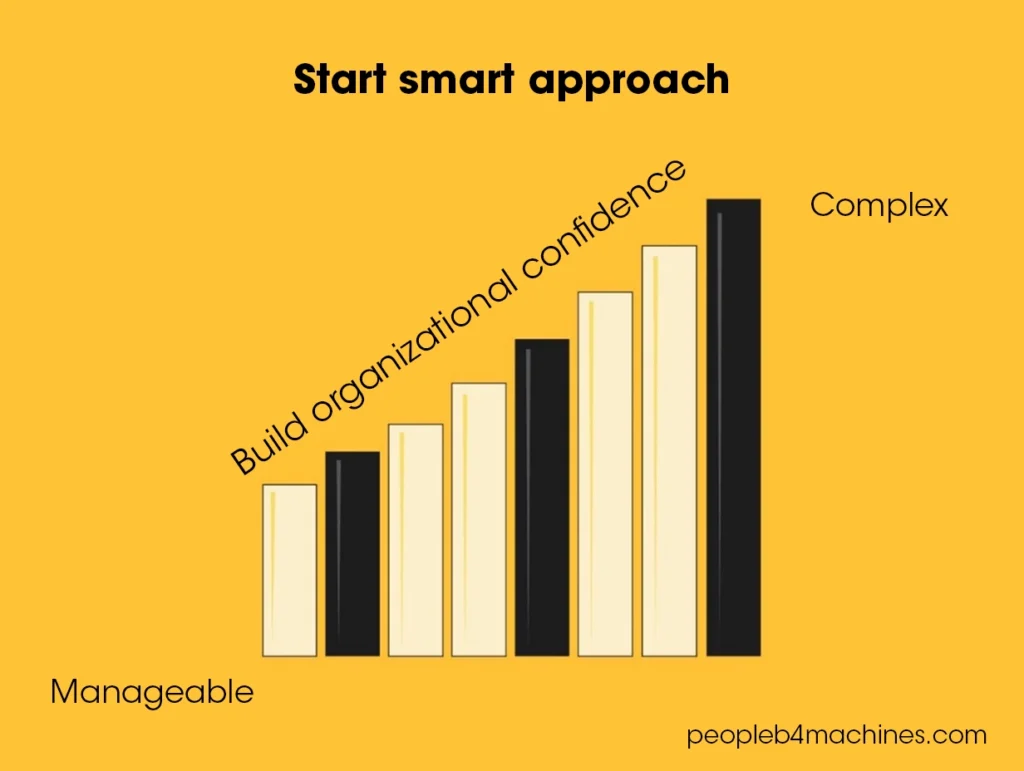
Burnstein advocates for a “start smart” approach: beginning with manageable automation projects that build organizational confidence rather than attempting complex implementations that risk failure.
“Start with something small. Build confidence among the entire organization that these things work, that they’re not a threat to our jobs and they’re actually making our jobs easier. Then scale it,” he suggested.
Successful companies focus on transparent communication, explaining not just what they’re implementing, but why it’s necessary for remaining competitive in a global market.
Partnership between people and technology
The key insight is reframing automation as a partnership between people and technology, not a replacement scenario.
“Your people are the most important asset that you have in your organization,” Burnstein advised. “You have to make sure that if the implementations don’t go exactly the way you thought, they’re not being blamed or feeling under the gun – that’s the wrong way to do it.”
Companies that succeed emphasize how automation eliminates dangerous, repetitive tasks while creating opportunities for workers to engage in higher-value activities requiring critical thinking and problem-solving skills.

Leadership’s role in automation
Middle management plays a crucial role as communicators and advisors, but ultimate responsibility for automation success rests with top leadership.
“Top management owns what happens with automation,” Burnstein said.
The most effective approach involves setting realistic ROI expectations, developing proper metrics that capture the full operational impact, and maintaining focus on people as the organization’s most important asset throughout the transformation process.
Bridging the gap between the top floor and the shop floor requires more than new technology, it demands clear communication, realistic expectations, and a people-first mindset.
By starting smart, fostering transparency, and positioning automation as a partnership, leaders can transform hesitation into collaboration and unlock the full value of automation for long-term success.

Is everyone having the same conversation on automation? Clear communication turns plans into progress. See how Eclipse Automation helps manufacturers align leadership and operations to deliver lasting results.