

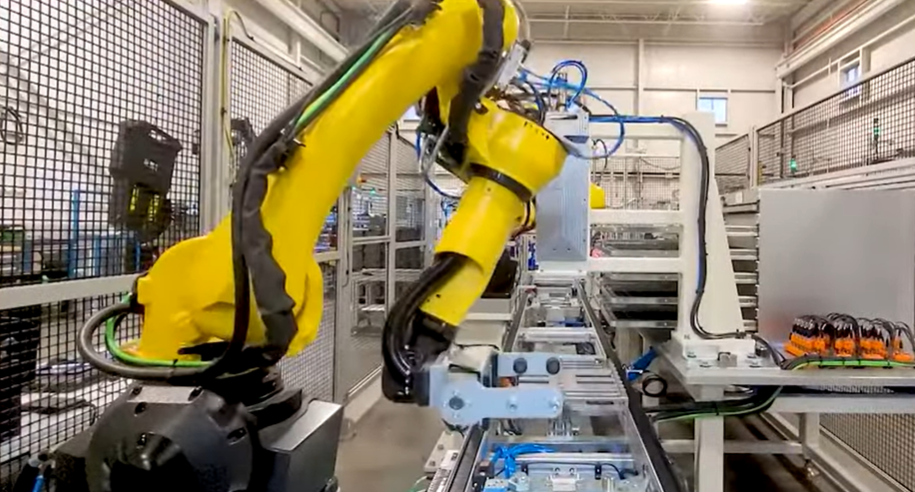



Manufacturers are under pressure to produce more with fewer resources. Labor shortages, rising costs, quality control issues, safety risks, and shifting customer demand are making traditional production models harder to sustain. These are some of the most common industrial automation challenges facing manufacturers today.
Smart manufacturing solutions help teams solve these challenges by combining robotics, artificial intelligence, machine vision, control systems, and real-time production data. The result is a more efficient, flexible, and resilient factory floor.
Below are six key industrial automation challenges manufacturers face, along with practical ways automation can help solve them.
1. Labor shortages and productivity pressure
Skilled labor shortages are making it harder for manufacturers to maintain output, especially in repetitive, high-volume, or technically demanding processes. Industrial automation helps reduce dependence on manual tasks while supporting consistent, around-the-clock production.
Programmable automation systems also support faster changeovers, which helps manufacturers increase productivity without constantly retraining staff or rebuilding production workflows.
2. Quality control and production consistency
Inconsistent quality can lead to scrap, rework, delays, warranty claims, and customer dissatisfaction. Automated systems improve repeatability by performing production steps with the same level of precision every time.
Machine vision systems and AI-driven inspection can detect defects earlier in the process, giving manufacturers better quality control and reducing the cost of downstream errors.
3. Rising operational costs
Rising labor, energy, material, and maintenance costs can quickly reduce margins. Automation helps manufacturers control operational costs by streamlining production processes, reducing waste, and improving equipment utilization.
Predictive maintenance and real-time monitoring can also help teams reduce unplanned downtime, extend equipment life, and allocate resources more effectively.
4. Workplace safety risks
Manufacturing environments often include repetitive motion, heavy lifting, sharp components, high temperatures, and other safety risks. Industrial automation can help move workers away from hazardous or physically demanding tasks.
Integrated safety controls, sensors, and guarded systems support safer operations while helping teams maintain production efficiency.
5. Scalability and production flexibility
Manufacturers need to respond quickly to new products, changing volumes, supply chain shifts, and customer requirements. Flexible automation systems make it easier to adapt production without starting from scratch.
Scalable smart manufacturing solutions support faster launches, more agile workflows, and production lines that can grow or pivot as demand changes.
6. Limited production data and visibility
Without accurate production data, it is difficult to identify bottlenecks, forecast issues, or make informed process improvements. Modern automation solutions generate real-time data across equipment, lines, and workflows.
Manufacturers can use these insights to improve performance, reduce downtime, optimize maintenance, and make smarter decisions across the factory floor.
Future-ready manufacturing starts with automation
The benefits of industrial automation go beyond faster production. With stronger quality control, lower costs, safer operations, and greater flexibility, automation helps manufacturers build more resilient operations for Industry 4.0.
By investing in the right smart manufacturing solutions, businesses can overcome production challenges, respond faster to market shifts, and deliver smarter, more sustainable products with greater efficiency.
Article updated July 2026
FAQs
Frequently asked questions
What is industrial automation?
Industrial automation uses robotics, control systems, artificial intelligence, sensors, and software to operate production processes with minimal manual intervention. It helps manufacturers improve productivity, quality, safety, and efficiency.
How does automation help solve labor shortages in manufacturing?
Automation helps manufacturers keep production running even when skilled labor is limited. Automated systems can handle repetitive, precise, or physically demanding tasks, allowing employees to focus on higher-value work.
How do machine vision systems improve quality control?
Machine vision systems inspect products in real time, helping detect defects earlier and more consistently than manual checks. This can reduce rework, scrap, and warranty claims while improving overall production quality.
Can automation reduce long-term operational costs?
Yes. Automation can reduce long-term costs by improving throughput, reducing waste, lowering downtime, optimizing energy use, and supporting predictive maintenance. The return depends on the production process, system design, and business goals.
Is automation flexible enough for changing production demands?
Yes. Modern automation is built for flexibility, not just fixed, repetitive tasks. Smart manufacturing systems can adapt to new products, materials, and volumes, helping manufacturers scale or pivot without rebuilding production lines from scratch.
Explore the possibilities
Ready to solve your production challenges? Book a discovery call to learn how Eclipse Automation supports smart manufacturing solutions that improve productivity, quality, safety, and flexibility.
Related articles and insights
-

How factory digital twins support production ramp up
Factory digital twins support production ramp up by pulling validation forward. Engineering teams debug PLC code,…
-

Understanding brownfield mobility automation failures
Brownfield mobility automation rarely fails because of the robot. Existing plants bring control logic written years…
